
As an Amazon Associate, we earn from qualifying purchases. This post contains affiliate links, and buying through one costs you nothing extra.
Finding the best camera for Blender motion capture depends on whether you need a professional cinema-grade sensor or a specialized industrial tool. Because motion capture often requires high frame rates or global shutter technology, your choice should match your workflow. For professional animation, the Canon EOS R6 Mark II is the standard, while those focused on precision motion analysis should look toward the IFWATER Global Shutter USB3.0 Camera.
1. Canon EOS R6 Mark II Body with Stop Motion Animation

Best for: Professional animators needing high-resolution frames and cinematic color depth.
This camera is built for creators who need professional-grade image quality and integration with specialized animation software like Dragonframe. Its full-frame 24.2 megapixel sensor provides the detail necessary for high-end production, while the DIGIC X processor ensures fast performance. The increased live view resolution helps when composing shots for stop motion.
The Dual Pixel CMOS AF II system provides wide coverage, which is vital for keeping subjects in focus during complex animation sequences.
Good if:
- You use professional animation software like Dragonframe.
- You require a full-frame sensor for high-quality textures.
- You need reliable, professional-grade autofocus performance.
Skip it if:
- You want a simple, plug-and-play webcam solution.
- You have no interest in manual camera settings.
2. OBSBOT Tail 2 PTZR NDI Camera 4K@60FPS

Best for: Content creators requiring automated AI tracking for live broadcasts.
The Tail 2 uses a PTZR lens design that allows for seamless switching between portrait and landscape modes. Its AI Tracking 2.0 system is the standout feature, allowing for group tracking and “Only Me” modes that lock onto a target automatically. This is ideal for creators who need to move around their space while the camera keeps them perfectly in frame.
The camera offers multiple connectivity options, including NDI, HDMI, and SDI, which simplifies the integration into existing production systems.
Good if:
- You need to move around your studio while filming.
- You want to integrate your footage into an NDI workflow.
- You require automated vertical and horizontal framing.
Skip it if:
- You need a camera for scientific-grade motion capture.
- You prefer full manual control over every lens parameter.
3. DJI Osmo Pocket 3 Creator Combo

Best for: Vlogging and capturing movement on the go with stabilization.
This camera is designed for portability, featuring a 1-inch CMOS sensor that handles 4K at 120fps. The 3-axis mechanical stabilization ensures smooth footage while moving. Its rotating 2-inch touchscreen makes it easy to switch between horizontal and vertical shooting.
The ActiveTrack 6.0 allows the camera to stay locked on a subject, making it useful for solo creators who need to be their own camera operator.
Good if:
- You need a portable, handheld device for mobile content.
- You want professional 10-bit color for easier post-production grading.
- You need smooth, stabilized footage without a tripod.
Skip it if:
- You need a fixed, industrial-grade camera for machine vision.
- You require a camera that stays connected to a computer 24/7.
4. 230fps Ultra High Speed 4K USB3.0 Camera
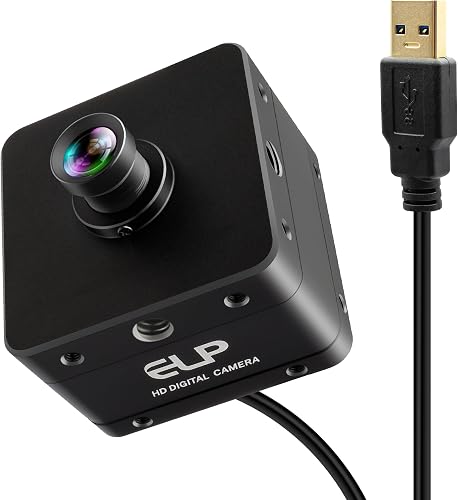
Best for: Users needing a wide field of view for high-speed analysis.
This camera provides a 71° field of view with a no-distortion lens, which is critical when you need to maintain spatial accuracy in your captures. It supports up to 230fps at 1080P, making it a strong candidate for capturing fast-moving actions like golf swings or mechanical movements. The USB 3.0 interface ensures fast data transfers.
Because it’s a UVC-compliant device, it works as soon as you plug it into your computer.
Good if:
- You need a distortion-free lens for accurate measurements.
- You require high frame rates for fast-moving subjects.
- You want a simple, driver-free setup for your computer.
Skip it if:
- You’re filming in low-light conditions.
- You need to adjust the focal length during a shot.
5. 640fps USB Camera Ultra High Speed Monochrome Global Shutter

Best for: Industrial precision and research where rolling shutter artifacts are unacceptable.
Global shutter technology exposes the entire sensor at once to eliminate rolling shutter distortion. With a 4X manual zoom lens and monochrome sensor, this camera is built for contrast and detail in research or engineering projects.
The camera is for users comfortable adjusting manual exposure and gain.
Good if:
- You need to eliminate rolling shutter distortion entirely.
- You’re performing scientific or industrial motion analysis.
- You require a monochrome sensor for higher contrast.
Skip it if:
- You need color video for your animation projects.
- You want an automated focus system.
6. Insta360 Link 2

Best for: Desktop streamers who need professional-looking bokeh and AI tracking.
The Link 2 uses a 1/2″ sensor to achieve a natural depth of field. Its AI tracking follows your position for presentations or streaming. Dedicated software allows you to fine-tune your settings.
It is not a motion capture tool for animation or 3D modeling. It lacks the frame rates and sensor tech required for fast mechanical motion or 3D tracking software.
Good if:
- You want a professional look for your video calls.
- You need AI tracking that follows you across your room.
- You want a compact device that sits on your monitor.
Skip it if:
- You need to capture high-speed motion for analysis.
- You require a camera that works outside of a desktop environment.
7. Global Shutter Module

Best for: Hidden installations where a small, flat form factor is required.
This module is extremely compact, measuring only 38mm x 38mm, making it perfect for custom rigs where space is limited. The global shutter sensor ensures that your high-speed captures remain sharp and free of the jelly-like distortion found in standard sensors. It’s a board-level solution for users building their own camera rigs.
The module lacks a protective housing or tripod mount.
Good if:
- You have very limited space in your camera rig.
- You need a global shutter for high-speed analysis.
- You’re comfortable with DIY hardware integration.
Skip it if:
- You want a finished camera with a protective case.
- You need a plug-and-play solution for a home office.
8. Elgato Facecam 4K

Best for: Streamers who want DSLR-like manual controls in a webcam.
The Facecam 4K is built for studio use, featuring a Sony STARVIS 2 sensor that provides excellent clarity. The Elgato Camera Hub software lets you control parameters like exposure and focus, giving you the kind of manual adjustments usually reserved for dedicated mirrorless cameras. It even supports standard 49mm lens filters if you want to add specific lighting effects.
Good if:
- You want to use standard lens filters on your webcam.
- You prefer granular manual control over your stream settings.
- You need reliable, high-resolution video for professional conferencing.
Skip it if:
- You need a camera for motion analysis or 3D tracking.
- You want an automated camera that handles all settings for you.
9. Global Shutter USB3.0 Camera

Best for: Industrial monitoring where you need both zoom and high-speed capture.
This camera combines a global shutter sensor with a 10X manual varifocal lens, making it one of the most versatile options for industrial inspection. It can handle fast-moving targets without rolling shutter skew, and the adjustable zoom lets you change your perspective without moving the camera. Its rugged metal housing is built to withstand more demanding environments than standard plastic webcams.
Good if:
- You need to zoom in on specific parts of a machine.
- You require a rugged, metal-bodied camera for industrial use.
- You need to capture fast motion without any image skew.
Skip it if:
- You’re looking for a simple webcam for home use.
- You aren’t comfortable performing manual focus and zoom adjustments.
10. Panasonic LUMIX GH6

Best for: Filmmakers who need professional video features and internal recording.
The GH6 is a high-end mirrorless camera that offers internal ProRes recording. Its 5-axis stabilization is effective for handheld shooting. Unlimited recording time is a benefit for animation, preventing project interruptions.
This is a professional filmmaking tool. It is complex and requires significant investment in lenses and accessories.
Good if:
- You need professional video features like ProRes internal recording.
- You want a camera that can handle long, continuous shoots.
- You need powerful in-body stabilization for handheld work.
Skip it if:
- You only need a camera for simple motion capture tasks.
- You don’t want to invest in a lens ecosystem.
Choosing the best camera for Blender motion capture
Most of these cameras fall into two distinct groups: consumer-grade webcams and professional-grade industrial sensors. The Insta360 Link 2, Elgato Facecam 4K, and OBSBOT Tail 2 overlap heavily in their focus on streaming, AI tracking, and ease of use. If your goal is to look good on camera for a video call or a stream, these three are functionally similar, and the choice between them comes down to whether you prefer the AI tracking of the OBSBOT or the manual control and filter support of the Elgato. Conversely, the various IFWATER and Hotpet global shutter models are functionally similar, all serving the niche of motion analysis. Choosing between those is mostly a matter of your specific mounting and focal length requirements.
Still Not Sure?
How often will I really use it for motion capture?
If you’re only dabbling in Blender animation, a professional cinema camera like the Canon EOS R6 Mark II might be more than you need. However, if you’re building a permanent studio for motion analysis, you should prioritize the durability and specialized sensors of the IFWATER Global Shutter USB3.0 Camera.
What do I already own that this must work with?
Check your current software compatibility. If you’re already using Dragonframe, the Canon EOS R6 Mark II is the most straightforward choice. If you’re building a custom machine vision project on a Raspberry Pi, the Global Shutter Module or the IFWATER 640fps Global Shutter camera will be much easier to integrate than a consumer webcam.
What am I most likely to regret choosing?
The most common regret is buying a camera that lacks the specific shutter type you need. If you buy a standard webcam for fast-moving motion capture, you’ll likely see rolling shutter artifacts that ruin your data. Always confirm if your project requires a global shutter, like the one found in the Global Shutter USB3.0 Camera, before committing to a purchase.
Professional motion capture relies on standardized frames to ensure data integrity during post-processing; for more information on these technical requirements, see the International Organization for Standardization guidelines on image capture.
Frequently Asked Questions
Can I use a standard webcam for 3D motion capture in Blender?
While you can technically use a standard webcam, they often suffer from rolling shutter artifacts that distort fast movement, making them unsuitable for high-precision 3D tracking. For serious work, a camera with a global shutter, such as the IFWATER Global Shutter USB3.0 Camera, is much more effective because it captures the entire frame simultaneously.
Does the camera need a specific frame rate for motion capture?
Yes, higher frame rates are generally better to ensure smooth motion data, but you must balance this with lighting. Many high-speed cameras, like the 640fps Global Shutter model, require significant ambient light to maintain clarity at their maximum frame rates. Always ensure your studio setup provides enough light to support the speeds you intend to record.
How do I connect these cameras to my computer for tracking?
Most industrial cameras, including the Hotpet Global Shutter Module, use a simple USB 3.0 plug-and-play connection that’s UVC-compliant. This means your computer will recognize them like a standard webcam, allowing software like Blender or tracking plugins to access the video stream without needing complex drivers or proprietary bridge software.
Is a manual lens better than an autofocus lens for this task?
For industrial motion capture or fixed-position analysis, a manual lens like the one on the IFWATER 640fps Global Shutter camera is often better. It allows you to lock the focus and zoom settings so the camera doesn’t hunt for focus during your capture, which provides more consistent data for your 3D software to process.
Conclusion
Choosing the right gear is just the start of your animation journey. Once you’ve picked your camera, spend some time calibrating your lighting to ensure the software tracks your movements accurately. You’ll be surprised at how much smoother your results look when the data is clean and easy to edit.