

As an Amazon Associate, we earn from qualifying purchases. This post contains affiliate links – if you buy through them, we may earn a commission at no extra cost to you.
There’s no single best gpu for substance painter for every 3D artist. The right card depends on your project size and PC power supply. Some texture artists need massive video memory for heavy multi-tile UDIM workflows, while others need standard cooling that fits inside a regular desktop case. Cards on this list differ mainly by their memory size, cooling design, and physical form factor rather than simple speed ranks. The NVD RTX PRO 6000 suits heavy studio pipelines, while the GIGABYTE GeForce RTX 5080 serves standard workstations.
1. GIGABYTE GeForce RTX 5080 Gaming OC 16G Graphics Card

Best for: 3D artists painting heavy 4K textures daily in professional desktop workstations.
This card targets artists who need strong daily performance without buying a specialized server card. Powered by NVIDIA Blackwell and DLSS 4, it brings modern acceleration to your workstation. Its 16GB GDDR7 memory provides fast texture caching.
Fast GDDR7 memory speeds up viewport interactions for high-resolution texture sets. However, 16GB of VRAM limits artists loading dozens of 8K UDIM tiles. Exceeding this memory ceiling causes viewport stuttering or texture downscaling.
Good if:
- You paint detailed game assets using modern layer-heavy workflows.
- You want the fast processing speeds of the Blackwell architecture.
- Your desktop chassis accommodates standard triple-fan cooling layouts.
Skip it if:
- You manage massive film-resolution scenes requiring over 16GB of memory.
- You use a compact mini-ITX computer chassis.
2. NVD RTX PRO 6000

Best for: Enterprise studios rendering massive multi-UDIM 8K assets without running out of VRAM.
Built for heavy enterprise demands, this professional card tackles massive 3D and AI pipelines. It carries 96 GB of GDDR7 ECC memory, preventing out-of-memory crashes on dense meshes. The card uses 5th Gen Tensor Cores and 4th Gen Ray Tracing Cores, paired with a modern PCIe Gen 5 interface. DisplayPort 2.1 outputs allow you to drive high-resolution workstation setups up to 8K at 240 Hz or 16K at 60 Hz.
The double-flow-through cooling sustains peak performance under 600W. Buyers outside the US require export licenses.
Good if:
- You handle massive film textures across dozens of 8K UDIM sets.
- You require error-correcting ECC memory to avoid project corruption.
- Your workstation power supply can comfortably support 600W power loads.
Skip it if:
- You lack enterprise-grade cooling and high-wattage power supplies.
- You live outside the US and want to avoid export licensing paperwork.
3. ASRock Radeon AI PRO R9700 Creator 32GB Professional Graphics Card

Best for: Multi-GPU workstation users who need dense rack mounting and dedicated blower cooling.
This two-slot card maximizes density in server racks and multi-GPU setups. It features 32GB of GDDR6 memory for large texture layers and complex rendering. It features AMD RDNA 4 architecture with 64 Compute Units, 3rd Gen Ray Tracing, and 2nd Gen AI Accelerators. Connectivity includes PCIe 5.0 and four DisplayPort 2.1a ports.
The blower cooler exhausts warm air out of the chassis, keeping adjacent cards cool. A metal shroud, backplate, and vapor chamber ensure stability for 24/7 operation. However, rear blower fans are louder than open multi-fan designs.
Good if:
- You install several graphics cards right next to each other inside one machine.
- You need a generous 32GB memory buffer for dense production scenes.
- You need server-grade materials meant for uninterrupted daily operation.
Skip it if:
- You want an ultra-quiet fan profile while baking textures at your desk.
- You prefer desktop gaming-style open-fin cooling arrangements.
4. GIGABYTE GeForce RTX 5070 Ti Gaming OC 16G Graphics Card

Best for: Production texture artists who want high-speed memory and balanced desktop thermal management.
This card offers modern features for standard production pipelines. It runs on the NVIDIA Blackwell architecture with DLSS 4 support and features a 16GB GDDR7 memory interface running on a 256-bit bus. PCIe 5.0 ensures rapid asset transfers between storage and the card. GIGABYTE’s WINDFORCE cooling system keeps graphics processing steady.
Good if:
- You create high-resolution digital props for games or real-time engines.
- You want modern GDDR7 memory speeds on a high-bandwidth memory interface.
- Your motherboard takes full advantage of high-speed PCIe 5.0 lanes.
Skip it if:
- You regularly build massive film environments that exceed 16GB VRAM.
- Your computer case can’t accommodate a large multi-fan graphics card.
5. GIGABYTE Radeon RX 9070 XT Gaming OC 16G Graphics Card
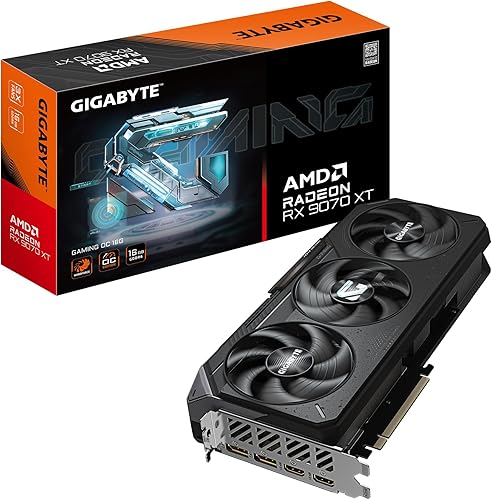
Best for: Artists who prefer an AMD GPU architecture with reinforced thermal gel cooling.
This graphics card pairs AMD’s Radeon RX 9070 XT core with 16GB of GDDR6 memory to handle modern 3D texturing tasks. It uses high-bandwidth PCIe 5.0 to maintain fast asset streaming between your system drive and viewport memory. GIGABYTE equips this model with WINDFORCE cooling and server-grade thermal gel for reliable heat transfer. Customizable RGB lighting is also integrated into the exterior shroud.
Good if:
- You build an all-AMD creative workstation running display pipelines over PCIe 5.0.
- You need a resilient thermal gel setup for long texturing sessions.
- You want a capable 16GB card for standard game asset creation.
Skip it if:
- You rely on software tools that require proprietary NVIDIA CUDA support.
- You want the faster memory transfer rates provided by GDDR7.
6. ASUS SFF-Ready Prime NVIDIA GeForce RTX 5070 Graphics Card (PCIe

Best for: 3D modelers working inside compact or small-form-factor desktop computer cases.
Engineered with an SFF-Ready layout, this card fits easily into tight small-form-factor builds. It runs on the NVIDIA Blackwell architecture with DLSS 4 and features 12GB of modern GDDR7 memory. ASUS includes a 2.5-slot profile alongside custom Axial-tech fans that feature longer blades and a barrier ring for downward air pressure.
The 2.5-slot footprint gives you excellent case compatibility while preserving active cooling airflow over the vital components. However, its memory capacity stops at 12GB, which is the lowest VRAM pool among the newer options on this list. You will reach the memory limit faster than on 16GB cards. It isn’t suitable for texture artists who routinely paint heavy multi-tile UDIM projects.
Good if:
- You build a clean, compact workstation using a space-saving PC case.
- You want the security supported by a 3-year manufacturer warranty.
- You prefer the flexibility of switching between Dual BIOS cooling profiles.
Skip it if:
- You routinely work on high-density meshes that require 16GB of VRAM or more.
- You run ultra-dense scenes that spill over a 12GB memory footprint.
7. ASUS Dual GeForce RTX 5060 Ti 16GB GDDR7 OC Edition
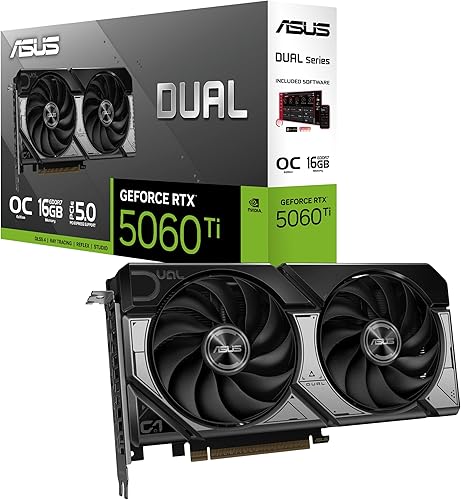
Best for: Solo freelancers wanting quiet operation and long fan lifespan in smaller workspaces.
This card is built for everyday texturing tasks, pairing the NVIDIA Blackwell architecture with 16GB of GDDR7 memory. It features an OC mode reaching 2632 MHz alongside an AI performance metric rated at 767 AI TOPS. ASUS utilizes dual-ball fan bearings that last up to twice as long as traditional sleeve-bearing designs. Its 2.5-slot chassis fits tight builds, while 0dB technology stops the fans entirely during light tasks for complete silence.
The dual-ball fan design ensures mechanical longevity if you bake textures or render assets for many hours each day. A physical Dual BIOS switch toggles between Quiet and Performance modes. While it packs 16GB of VRAM, its underlying core configuration targets entry-level professional workflows rather than top-tier rendering speed.
Good if:
- You prioritize long hardware longevity through dual-ball fan bearings.
- You prefer total quiet during basic asset inspection using 0dB mode.
- You want a full 16GB VRAM buffer inside a space-saving 2.5-slot card.
Skip it if:
- You need top-tier processing speeds for commercial rendering deadlines.
- You work in large studio teams running continuous heavy render batches.
8. ASRock Radeon RX 9060 XT Challenger 16GB OC

Best for: Asset painters with smaller cases and modest 550W desktop power supplies.
This compact 249 mm dual-slot card fits easily into standard computer towers. It requires one 8-pin connector and a 550W power supply. The card is powered by AMD RDNA 4 architecture with 32 Compute Units, 3rd Gen Ray Tracing, and 2nd Gen AI Accelerators. It clocks up to a 3290 MHz boost clock and features 16GB of GDDR6 memory running at 20 Gbps.
The single power plug and modest 550W requirement let you upgrade older systems without replacing your existing power hardware. Its physical 2-slot size leaves surrounding motherboard expansion slots unobstructed for add-in cards. However, its 16GB memory pool runs on a narrower bus, which restricts overall memory bandwidth compared to wider, more robust alternatives. It isn’t for high-end artists who need maximum data transfer speeds across huge texture caches.
Good if:
- Your current PC uses a standard 550W power supply with one 8-pin plug.
- You have limited physical length inside your desktop chassis.
- You want 16GB of VRAM without altering your system power configuration.
Skip it if:
- You need high-bandwidth memory for rapid 8K texture manipulation.
- Your production software suite performs best on NVIDIA CUDA frameworks.
9. MSI GeForce RTX 5070 Ti 16G Ventus 3X OC Graphics

Best for: Artists seeking heavy-duty heatsink contact and high-pressure airflow for long rendering sessions.
This card is designed around continuous thermal control, utilizing MSI’s triple-fan thermal layout with TORX Fan 5.0 technology. The cooling assembly features square-shaped Core Pipes that maximize physical contact against the nickel-plated copper baseplate. It carries 16GB of GDDR7 memory operating across a 256-bit bus at 28Gbps over a modern PCIe 5.0 connection. The manufacturer requires a minimum 750W system power supply for proper operation.
Good if:
- You want dedicated copper baseplate cooling for both memory and GPU cores.
- Your workstation chassis easily handles large triple-fan card dimensions.
- Your power supply meets or exceeds the required 750W capacity.
Skip it if:
- You operate a computer equipped with a power supply smaller than 750W.
- You’re assembling a compact small-form-factor workspace computer.
10. EVGA GeForce RTX 3090 FTW3 Ultra Gaming

Best for: 3D artists who need a large 24GB memory buffer for complex multi-layer texturing.
The EVGA GeForce RTX 3090 FTW3 Ultra Gaming provides 24GB of GDDR6X memory. Its graphics processor houses 10,496 CUDA Cores and operates with an 1800MHz boost clock for heavy creative workloads. It features a triple-fan cooling system, ARGB lighting, and a metal backplate. Video connectivity includes standard HDMI and DisplayPort outputs.
The 24GB frame buffer provides breathing room when texturing dense assets that cause 12GB or 16GB cards to run out of memory. Its metal backplate adds structural rigidity across the lengthy circuit board to prevent physical warping inside standard vertical motherboard mounts.
Good if:
- You need 24GB of dedicated memory for complex layer stacks.
- Your current workstation motherboard uses a standard interface slot from the previous generation.
- You prefer triple-fan open-air cooling with an integrated metal backplate.
Skip it if:
- You require the latest high-bandwidth PCIe 5.0 or GDDR7 technologies.
- The listing states no further limits, so we stop here.
Finding the Best GPU for Substance Painter
The ASUS TUF Gaming GeForce RTX features 12GB of GDDR7 memory in an OC Edition configuration for gaming and 3D modeling tasks.
The ASUS TUF Gaming GeForce RTX™ provides 16GB of GDDR7 memory built on a durable gaming-grade layout for sustained rendering stability.
Where These Overlap
Several cards on this list share nearly identical core technical foundations. Similarly, the 16GB GDDR7 memory pool on the RTX 5080 options handles identical asset sizes, leaving the physical chassis design and clock profiles as the only practical differences.
Still Not Sure?
How large are your typical texturing projects?
If you texture standard single-tile props for games, a 12GB or 16GB card handles your layers smoothly. Artists painting complex multi-UDIM film assets with dozens of 8K maps need massive memory buffers to prevent system stutter. For huge scenes, choose the 96GB capacity on the NVD RTX PRO 6000.
What kind of PC case and power supply do you own?
Check your power supply wattage and case length. Large triple-fan cards demand up to 750W supplies and substantial clearance, while compact models fit smaller enclosures. If you use a modest desktop with a 550W power supply, choose the compact ASRock Radeon RX 9060 XT.
Do your everyday tools require specific software features?
Certain rendering engines and simulation plug-ins perform best when running on NVIDIA CUDA cores rather than generic compute frameworks. Check your pipeline requirements to ensure software compatibility. If you need standard NVIDIA architecture with strong everyday performance, select the GIGABYTE GeForce RTX 5080.
If you handle standard game textures, pick the GIGABYTE GeForce RTX 5080 for balanced workstation performance.
Frequently Asked Questions
What does this hardware ask of its owner week to week?
Keep your case dust filters clean so airflow passes smoothly through the cooling fins. Update your graphics drivers regularly to ensure your 3D painting software runs without viewport errors or unexpected tool crashes. Consult the Adobe Substance 3D technical requirements for official maintenance guidance.
Does anything on the graphics card need replacing over time?
Graphics cards don’t contain consumable items that require routine replacement during normal use. The fans are the only moving parts and are built to spin for years without maintenance. Keep the heatsink fins free of debris so the factory thermal pads maintain proper contact.
What happens when you outgrow your card’s video memory?
When your project exceeds VRAM, software must stream assets through slower system RAM. This causes sluggish brush strokes, slow material loading, and occasional export crashes during heavy texture baking.
Would a more capable workstation card suit your workflow better?
A massive workstation card is only worth it if your projects fill standard memory buffers. Buy the larger memory configuration only when your projects routinely exceed standard 16GB capacities.
Conclusion
Choosing the right hardware shouldn’t feel like a chore. Once you’ve settled on a card that fits your budget and case, you’ll find that painting complex materials becomes much smoother. You shouldn’t hesitate to check your current power supply’s wattage today, as it’s the most common hurdle when upgrading your workstation.