
As an Amazon Associate, we earn from qualifying purchases. This post contains affiliate links – if you buy through them, we may earn a commission at no extra cost to you.
Finding the right espresso machine isn’t about chasing the longest feature list. It’s about matching what’s inside the machine to how you actually make coffee each morning, because a complex setup won’t help if you don’t have time to learn it. This page breaks down the real differences in grinders, heating systems, and milk frothing so you can choose based on capability rather than marketing claims. For most people starting out who want fresh grounds without buying separate gear, the Breville Barista Express remains the standard pick because its integrated conical burr grinder delivers consistent doses directly into the portafilter.
What Actually Matters
Integrated Grinder Quality
A built-in grinder saves counter space but locks you into its performance forever. Conical burrs are preferred over blades for uniform particle size, which prevents sour or bitter shots from uneven extraction. Check the listed grind settings and whether the chute is designed to resist clogging with oily beans, as this determines your daily maintenance burden more than any other single specification on the sheet.
Heating System Speed
Traditional boilers take minutes to stabilize, while ThermoJet systems reach brewing temperature in seconds. Faster heat-up matters most on weekday mornings when waiting isn’t an option, though some purists argue traditional boilers offer superior thermal stability during back-to-back shots. Verify the manufacturer’s stated heat-up time and whether the system allows instant transition between brewing and steaming modes without a cool-down period.
Milk Frothing Method
Manual steam wands give you full control over texture but require practice to avoid burning milk or creating large bubbles. Automatic systems handle temperature and texture hands-free, which guarantees consistency but removes the ability to customize foam density for different drinks. Decide honestly whether you want to learn latte art technique or simply want a reliable cappuccino every time without adjusting variables.
Pressure Regulation Claims
Listings often advertise high bar pressure numbers, but 9 bars is the recognized standard for proper espresso extraction according to Specialty Coffee Association standards. Higher pump ratings don’t mean better coffee; they just indicate the motor’s maximum capacity before regulation valves reduce it to usable levels. Look for mentions of pre-infusion or PID temperature control instead, as these features actually influence flavor balance more than raw pressure specifications ever will.
1. Breville BES870XL Barista Express Espresso Machine

Best for: All-in-one grinding and brewing beginners
The integrated conical burr grinder delivers fresh grounds directly into the portafilter, eliminating the need for a separate grinder. Digital temperature regulation via PID ensures water hits the right temperature for extraction, while low-pressure pre-infusion gradually increases pressure to draw out flavors evenly before full force is applied. This combination means you get consistent results without needing advanced technical knowledge, though the manual steam wand still requires practice to master microfoam texture properly.
Pros
- Integrated conical burr grinder ensures fresh grounds
- PID digital temperature control stabilizes extraction
- Low-pressure pre-infusion balances flavor extraction
- Manual steam wand enables latte art practice
- Grind size dial adjusts for different bean roasts
Cons
- Manual tamping requires consistent user technique
- Steam wand needs practice for proper microfoam
- Dialing in grind settings takes initial trial time
2. Breville BES878BSS Barista Pro Espresso Machine

Best for: Fast morning routines with fresh grinding
The ThermoJet heating system achieves precise extraction temperature in just three seconds, making this ideal for anyone who can’t wait ten minutes for a boiler to stabilize before their first cup. An LCD display shows grinding and extracting progress animations, providing visual feedback that helps beginners understand where they’re in the process without guessing.
Pros
- Three-second heat-up via ThermoJet system
- LCD display guides grinding and extraction visually
- PID maintains temperature within +/- 2°C
- Integrated conical burr grinder included
- Instant transition between brew and steam modes
Cons
- Redundant if owning separate quality grinder
- Premium features add complexity over basic models
3. Breville BES450BSS Bambino Espresso Machine

Best for: Small kitchens needing fast heat-up
Designed specifically for compact spaces, this machine fits easily on countertops where larger units would dominate the area. An automatic steam wand handles milk texturing hands-free at the correct temperature, removing the skill barrier that manual wands present while still producing microfoam suitable for latte art attempts using the included 54mm portafilter.
Pros
- Compact design fits tight kitchen spaces
- Three-second ThermoJet heat-up included
- Automatic steam wand textures milk hands-free
- PID digital temperature regulation ensures consistency
- Includes dual-wall filter baskets for beginners
Cons
- No integrated grinder requires separate purchase
- Automatic frothing limits foam texture customization
- Smaller drip tray fills faster during multiple drinks
4. Ninja Luxe Café Pro 4-in-1 Espresso Machine

Best for: Multiple drink types beyond espresso
This 4-in-1 machine handles espresso, drip coffee, cold brew, and hot water from a single unit, replacing several appliances for households with varied preferences. Barista Assist Technology guides users through automatic precision grinding, weight-based dosing, and integrated tamping at the pull of a lever, significantly reducing the guesswork that frustrates newcomers. The Dual Froth Pro system combines magnetic whisking with automatic steaming for hands-free microfoam, while cold-pressed espresso mode extracts at lower temperatures for smoother iced drinks without bitterness.
Pros
- Four brewing modes replace multiple appliances
- Barista Assist automates grinding and tamping
- Hands-free dual frothing system included
- Cold-pressed mode for smooth iced drinks
- Onboard accessory storage saves counter space
Cons
- Automation limits manual control options
- Extra functions unnecessary for espresso-only drinkers
5. De’Longhi Stilosa Compact Manual Espresso Machine

Best for: Simple manual operation without extras
The stainless steel boiler is engineered for longevity and straightforward operation, avoiding electronic complexity that can complicate repairs. Included accessories cover basics like portafilter, measuring scoop/tamper, and single/double filters, keeping the package focused on essential espresso preparation without bundled features that add unnecessary countertop footprint.
Pros
- Stainless steel boiler built for durability
- Manual steam wand allows full texture control
- Simple mechanical operation reduces failure points
- Essential accessories included without bloat
- Compact footprint suits limited spaces
Cons
- No integrated grinder requires separate purchase
- Lacks PID temperature control for stability
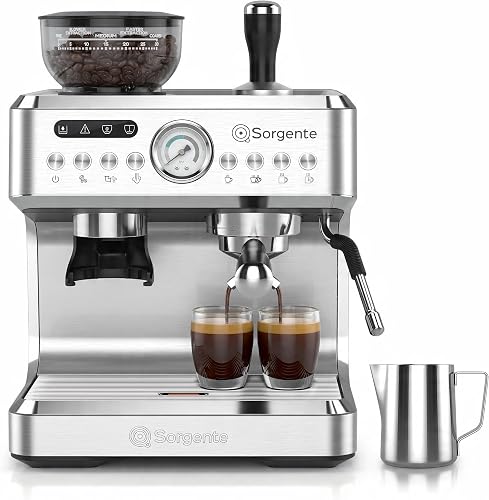
6. Sorgente Espresso Machine with Grinder
Best for: Mid-range grinding with clog prevention
The reinforced auger and wider chute design specifically addresses clogging issues common with oily dark roasts that jam lesser grinders. Thirty grind settings allow fine-tuning across roast profiles, while adjustable brew temperature lets you compensate for bean characteristics that extract differently at various heat levels. Professional 20-bar pressure works alongside these adjustments to produce rich crema, and the removable 2.6L water tank reduces refill frequency during entertaining or heavy use periods.
Pros
- Reinforced auger prevents oily bean clogs
- Twenty-five grind settings for precise tuning
- Adjustable brew temperature matches bean profile
- Large 2.6L removable water tank
- One-year warranty covers manufacturing defects
Cons
- PID inclusion unclear despite temp adjustment
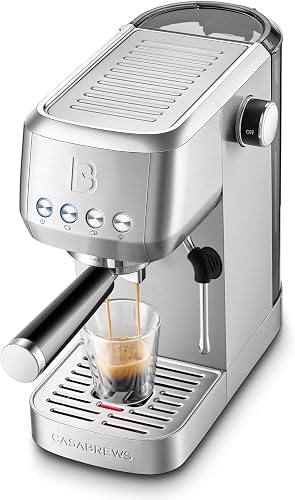
7. CASABREWS 3700 Essential Stainless Steel Espresso Machine with Steam Wand
Best for: Entry-level brewing without an integrated grinder
This machine focuses on core espresso extraction with a 20-bar professional pump and 1350W heating system, delivering fundamental capability without integrated grinding expenses. The powerful steam wand creates microfoam for latte art practice, while the 43.9 oz removable water tank supports multiple cups before refilling.
Pros
- 20-bar pump delivers adequate extraction pressure
- Powerful steam wand enables microfoam creation
- 43.9 oz tank minimizes refill interruptions
- Complete starter accessories included in box
- Compact stainless steel build suits small kitchens
Cons
- Requires separate grinder for fresh grounds
- Fixed parameters limit advanced technique growth
- No confirmed PID or pressure gauge included
8. SHARDOR 20 Bar Espresso Machine with Built-In Grinder

Best for: Buyers wanting integrated grinding
Forty-five precision grind settings paired with PID temperature control holding 194-204°F provide adjustment range typically found in higher-tier machines. Anti-static grinder design reduces clumping and scattering that wastes beans and creates mess, while the high-pressure pump with stainless steel portafilter extracts consistently across settings.
The listing notes dual-wall filter compatibility issues at finest settings, requiring users to stay within recommended ranges rather than exploring extremes.
Pros
- Forty-five grind settings with anti-static design
- PID holds 194-204°F brewing temperature
- Two-year warranty exceeds category averages
- Cold brew mode adds versatility
- Compact footprint fits tight spaces
Cons
- Finest grind settings incompatible with dual-wall filters
9. Mr. Coffee 4-Shot Steam Espresso Cappuccino and Latte Maker

Best for: Steam-brewed Cuban coffee preparation
Steam-brewing process produces dark, rich espresso particularly suited for Cuban coffee traditions that differ from Italian-style extraction. Extra-large portafilter brews up to four shots simultaneously, serving multiple people without repeated cycles that delay group enjoyment. Water pitcher with measurement markings ensures consistent ratios, while included stainless steel frothing pitcher eliminates need for separate milk steaming vessels.
Pros
- Steam brewing suits Cuban coffee traditions
- Four-shot capacity serves groups efficiently
- Measurement markings ensure consistent ratios
- Stainless steel frothing pitcher included
- Simple operation requires minimal learning
Cons
- Not designed for specialty coffee standards
- Steam brewing differs from pump extraction
- Limited control for single-origin nuances
10. CHULUX Slim Espresso Machine with Milk Frother

Best for: Narrow spaces requiring minimal width
At just 5.5 inches wide, this machine fits gaps where standard-width units physically can’t install. Preheating completes in thirty seconds via 1350W boiler, approaching ThermoJet speeds without that specific technology designation. Pressure gauge shows real-time extraction status, while pre-infusion function promotes balanced flavor development before full pressure engages.
Pros
- 5.5-inch width fits narrow spaces
- Thirty-second preheat approaches instant readiness
- Real-time pressure gauge monitors extraction
- Pre-infusion promotes balanced flavor
- Auto shut-off after 25 minutes inactive
Cons
- Slim profile may limit thermal stability
- 40 oz tank requires frequent refills
- No integrated grinder accommodation possible
Who Should Buy Which
The Breville Barista Express suits committed learners wanting integrated grinding without overwhelming automation, while the Barista Pro better serves time-pressed users needing near-instant readiness and visual guidance. First-time buyers fearing complexity should consider the Bambino’s automatic frothing or Ninja Luxe Café Pro’s Barista Assist technology. Those replacing failed machines wanting simplicity might prefer De’Longhi Stilosa’s mechanical reliability, whereas buyers needing grinding should evaluate SHARDOR’s two-year coverage. Space-constrained users have clear choices between Bambino’s compact depth and CHULUX Slim’s narrow width depending on their specific dimensional limitations.
Mistakes That Catch Buyers Out
- Judging machines solely by advertised bar pressure numbers instead of checking for PID temperature control and pre-infusion features that actually affect extraction quality.
- Choosing integrated grinders for convenience without verifying grind setting range and chute design, then discovering oily beans clog the mechanism daily.
- Assuming all steam wands produce identical microfoam when manual versions require significant practice while automatic ones remove customization options entirely.
- Taking “fast heat-up” claims at face value without distinguishing between ThermoJet instant readiness and traditional boiler stabilization times that vary considerably.
For most people, the Breville Barista Express offers the best balance of integrated grinding capability and learnable manual control. Before ordering, measure your available counter width and depth precisely, as even compact machines require clearance for portafilter insertion and steam wand movement that listing dimensions alone don’t convey.
Frequently Asked Questions
Does higher bar pressure mean better espresso?
No, nine bars is the recognized standard for proper extraction regardless of pump rating. Higher numbers indicate motor capacity before regulation, not brewing superiority. Focus on PID temperature control and pre-infusion features instead, as these actively influence flavor balance more than raw pressure specifications that exceed optimal ranges anyway.
Can I use pre-ground coffee with these machines?
Most accept pre-ground via dual-wall filter baskets included with many models. However, pre-ground coffee stales rapidly after grinding, compromising flavor significantly compared to fresh grounds. Machines without integrated grinders work with pre-ground but deliver noticeably inferior results that may disappoint expectations set by café experiences.
How important is PID temperature control really?
PID maintains stable water temperature throughout extraction, preventing sour or bitter shots caused by thermal fluctuation. Machines without it rely on passive boiler behavior that varies with ambient conditions and shot timing. For consistent results across different beans and times of day, PID represents meaningful functional difference worth prioritizing over cosmetic features.
Conclusion
Once your new setup arrives, don’t stress about pulling a perfect shot immediately. Spend a week dialing in your grind size and tasting the differences each morning. You’ll quickly learn what you like, and those early cups will start feeling like second nature.