As an Amazon Associate, we earn from qualifying purchases. This post contains affiliate links – if you buy through them, we may earn a commission at no extra cost to you.
Finding the 3 in 1 best blender 3d modeling practice for beginners depends on your specific goals, such as building characters, designing products, or creating game assets. Because Blender is a complex tool, these books differ mainly in their focus and the types of projects they ask you to complete. Readers usually split between those who want a broad foundation and those who prefer a niche focus, like sculpting or game design.
1. Blender 5.2 LTS Projects

Best for: Students who learn effectively by completing full, real-world projects.
This guide provides a practical path for beginners by focusing on 12 distinct projects. By working through these tasks, you see how the different parts of the software interact in a professional workflow. It’s designed for those who want to build a portfolio while they learn.
However, this book might not suit a user who prefers deep theoretical explanations over hands-on work. If you need a dense manual that covers every single menu button, this project-based approach could feel a bit fast-paced for your needs.
Good if:
- You have a basic interest in 3D art.
- You want to see immediate, tangible results.
- You’re building a professional portfolio.
Skip it if:
- You prefer reading theory before touching the software.
- You feel overwhelmed by jumping into projects immediately.
2. Blender 5.0 User Guide

Best for: Beginners who want a single, all-encompassing reference manual.
This book covers a wide range of topics from scratch, including sculpting, texturing, and animation. It acts as a complete guide, making it a solid choice if you don’t want to buy multiple books for different skills.
The trade-off here is the sheer amount of information provided. If you’re only interested in one specific field, such as character design, you may find the breadth of this book more than you need.
Good if:
- You want to learn all the main features.
- You’re starting with zero experience.
- You want one book that covers everything.
Skip it if:
- You only care about one specific niche.
- You find large, comprehensive guides intimidating.
3. Blender for 3D Printing and Product Design

Best for: Makers who intend to move their digital models into the physical world.
This book bridges the gap between digital modeling and physical creation. It teaches you mesh optimization and STL export, which are the technical requirements for 3D printing. It’s a specialized tool for someone who wants to see their designs printed on a machine.
If your goal is to make a feature-length film or a video game, the content here won’t fully support those specific ambitions.
Good if:
- You own or plan to use a 3D printer.
- You enjoy designing functional objects or figures.
- You want to learn how to prepare files for production.
Skip it if:
- You’re only interested in digital-only art.
- You want to learn character animation.
4. Blender for Game Creation

Best for: Aspiring game developers who need to build assets for interactive environments.
This guide focuses on the specific needs of game design, such as character design and asset building. It helps you understand how to create models that are efficient and ready to be imported into game engines. It’s a practical guide for those looking to start a career in games.
Because it’s tailored for games, it skips over some of the artistic sculpting workflows used in film. The listing doesn’t mention the specific topics covered in this book.
Good if:
- You want to work in the game industry.
- You need to learn about asset optimization.
- You’re interested in character and environment design.
Skip it if:
- You prefer artistic, non-interactive 3D modeling.
- You aren’t interested in technical game requirements.
5. Blender 3D Blueprint

Best for: Beginners who want a structured exercise for every chapter.
This book uses a masterclass approach with exercises built into every chapter. It’s particularly strong for those who find it hard to stay motivated without clear, frequent milestones.
The book is heavily focused on character creation. If you’re more interested in architectural visualization or abstract art, the exercises may not align with your personal creative interests.
Good if:
- You learn best through constant practice.
- You want to master character creation.
- You like having clear, bite-sized goals.
Skip it if:
- You want to model environments or architecture.
- You prefer a more flexible, non-exercise-based reading style.
6. Low Poly 3D Modeling in Blender

Best for: Artists who love the distinct, clean aesthetic of low-poly art.
This guide is for those who want to kickstart a career by mastering low-poly scenes. It’s a great starting point for someone who wants to develop a specific visual signature.
The limitation of this book is its narrow focus on a single aesthetic approach. If you decide later that you want to move into high-fidelity, realistic, or cinematic 3D art, you’ll need to find another resource to learn those distinct workflows.
Good if:
- You enjoy the low-poly look.
- You want to create game-ready assets quickly.
- You’re starting your journey as a 3D artist.
Skip it if:
- You want to learn photorealistic rendering.
- You’re interested in high-detail sculpting.
7. Sculpting the Blender Way

Best for: Artists who want to focus entirely on digital clay and sculpting.
This book dives deep into Blender’s sculpting tools, such as the cloth brush and mesh filters. It’s a highly specialized guide for those who view 3D modeling as a digital form of traditional sculpture. It’s the best choice for someone who wants to create organic shapes and characters.
It’s a deep dive into a specialized corner of the software, not a broad overview of the entire program.
Good if:
- You love digital sculpting.
- You want to master organic modeling.
- You’re interested in advanced brush techniques.
Skip it if:
- You want to learn how to render scenes.
- You’re interested in hard-surface mechanical modeling.
8. 3D Modeling and Animation with Blender

Best for: Beginners who want to focus on bringing their characters to life through motion.
This book guides you through the full process of building and animating a character. It’s an excellent choice for someone who wants to see their creations move. It provides a clear path from a static model to a fully animated result.
The book is quite specific to character animation. If you’re interested in abstract animation or motion graphics that don’t involve characters, the techniques here might not be the most relevant for your goals.
Good if:
- You want to learn character animation.
- You want to build a complete project from start to finish.
- You’re interested in storytelling through motion.
Skip it if:
- You have no interest in character design.
- You want to focus on static 3D scenes.
9. Blender Dummy-Proof Guide

Best for: Absolute beginners who find technical manuals intimidating.
It’s designed to make the barrier to entry as low as possible, even for those with no prior 3D experience. It’s a friendly, approachable way to get your first model finished.
The simplicity is both its strength and its limit. Once you move past the basics, you’ll likely need a more advanced book to handle professional-level workflows or complex technical challenges.
Good if:
- You’re brand new to 3D software.
- You want to learn at a very gentle pace.
- You appreciate simple, clear instructions.
Skip it if:
- You’re already comfortable with other software.
- You want a deep, technical dive into advanced features.
10. Digital Sculpting 2025
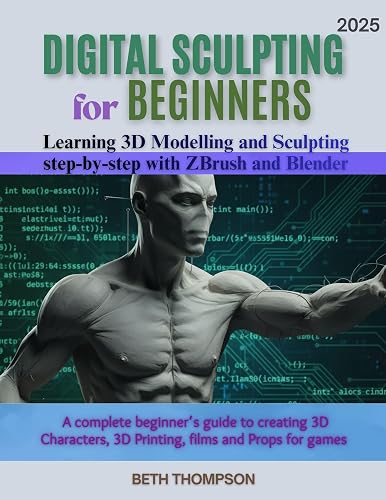
Best for: Beginners who want to learn both ZBrush and Blender.
This guide offers a look at a dual-software workflow, which is common in professional studios. By learning how to use both programs, you gain a broader perspective on the industry. It’s a great choice for someone planning to work in film or game studios.
The main trade-off is the complexity of learning two software packages at once. If you only want to master Blender, you may find the sections on ZBrush to be extra information that you don’t need right now.
Good if:
- You want to learn professional studio workflows.
- You’re interested in character sculpting for films.
- You want to use both ZBrush and Blender.
Skip it if:
- You only want to learn Blender.
- You’re easily overwhelmed by technical complexity.
Where These Overlap
Many of these guides cover the core fundamentals of 3D modeling, such as navigation, mesh editing, and basic rendering. For instance, Blender 5.2 LTS Projects, Blender 5.0 User Guide, and Blender Step-by-Step Guide 3D Modeling all provide a solid foundation for a beginner. If you’re truly undecided, these broad guides offer the most versatility. The differences only become significant when you choose a niche path, such as sculpting or game design. If your goal is to learn the software generally, any of the comprehensive guides will serve you well, and the specific choice between them is less important than simply starting your practice.
Still Not Sure?
How often will I really use it?
If you plan to model every day, you need a book that covers advanced workflows and optimization techniques to keep your work efficient. If this is just a hobby for the weekend, a simpler, project-based guide like Blender 5.2 LTS Projects will keep you engaged without feeling like a chore.
What do I already own that this has to work with?
Think about your hardware and your other software. If you have a 3D printer, the Blender 3D Printing Guide is essential. If you want to integrate your work into game engines, choose Blender for Game Creation. Always pick a book that complements the tools you already have in your workspace.
What am I most likely to regret choosing?
The most common regret is picking a highly specialized book when you really wanted a broad overview. If you aren’t sure what you want to specialize in yet, start with a comprehensive option like Blender 5.0 User Guide. You can always buy a specialized book for sculpting or animation later.
The choice of a 3D modeling guide often comes down to whether you prefer a broad, all-in-one manual or a specialized, project-based path. If you want a wide foundation, choose Blender 5.0 User Guide. If you want to build a portfolio through specific tasks, pick Blender 5.2 LTS Projects and begin your journey today.
Related guides
- 10 Best Game Engines for Blender: Top Picks for Your Projects
- 10 Best Blender Tutorial for Beginners Picks to Start Learning
Frequently Asked Questions
What does it ask of its owner week to week?
Consistent practice is essential to build the muscle memory required for 3D modeling interfaces. You should plan to spend a few hours each week following the exercises in your chosen book. The Blender Foundation provides official documentation that acts as a helpful companion to any book you choose.
What has to be replaced, refilled or renewed to keep it working?
These books don’t require refills or replacements, but the software itself updates regularly. You should check the version of Blender mentioned in your book. While the core skills remain the same, menu locations can shift, so keeping your software version aligned with your guide helps avoid confusion during lessons.
What happens when it’s outgrown or used up?
When you finish a beginner guide, you’ll likely find that your skills have grown to the point where you can start your own original projects. At that stage, you can move on to intermediate tutorials or specialized masterclasses that focus on specific industry techniques rather than basic software navigation.
Would the more capable one on this list have suited me better?
A more capable guide usually means a more technical one, not necessarily a better one for your current level. If you start with a book that’s too advanced, you may feel discouraged. It’s often better to master the basics with a simple guide before moving to advanced, comprehensive manuals.
Conclusion
Pick the project that excites you most and start building today. You don’t need to be perfect; you just need to keep practicing until the tools feel like an extension of your hands. It’s a rewarding journey, so don’t give up when things get tricky. You’ll be creating amazing scenes before long.