
As an Amazon Associate, we earn from qualifying purchases. This post contains affiliate links – if you buy through them, we may earn a commission at no extra cost to you.
Finding the best tile size for nvidia 1080 blender depends on balancing your specific rendering needs with the hardware limits of your card. Blender performance is often tied to how your GPU handles memory and thermals during long tasks. Choosing the right hardware requires looking at cooling designs, clock speeds, and memory capacity. Whether you prioritize raw power or compact size, the right choice depends on your workspace and how often you render complex scenes. Most users will find their match between the high-performance EVGA GTX 1080 Ti FTW3 or the space-saving ASUS Turbo 1080 Ti.
1. EVGA GeForce GTX 1080 Ti FTW3 Gaming

Best for: Professionals who need reliable, high-speed rendering for long, complex projects.
This card is built for users who push their hardware to the limit during daily production. It features a base clock of 1569 MHz and a boost clock reaching 1683 MHz, which helps speed up cycles in Blender. The iCX technology uses nine thermal sensors to monitor memory and VRM, ensuring the card stays stable during heavy work.
The vented heatsink and pin fin design are meant to keep air moving efficiently through the card. This design choice manages heat, but the card occupies more space, so you must check your case size first. It isn’t for someone with a small, cramped PC case where airflow is already restricted by other components.
Good if:
- You need constant monitoring of memory and VRM temperatures.
- You require high clock speeds for faster rendering times.
- You want a safety fuse to protect against electrical failures.
Skip it if:
- Your PC case has very limited internal clearance.
- You prefer a minimalist, non-RGB lighting setup.
2. EVGA GeForce GTX 1080 Ti SC Black Edition Gaming

Best for: Users who prioritize consistent thermal performance during extended rendering sessions.
Thermal management is vital when rendering, and this model uses an L-shaped contact fin design to improve surface area. By increasing the contact area, the card aims to dissipate heat more effectively than standard designs. It requires a 600-watt power supply to function, so you must ensure your current power unit can handle the load.
The card is designed for smooth, low-latency performance during both gaming and compute-heavy tasks. Because it focuses on cooling efficiency, it’s ideal for those who leave their machine running for hours at a time. It isn’t for users who have limited power supply capacity or lack the necessary 6-pin and 8-pin connectors.
Good if:
- You value optimized heat dissipation for long-term reliability.
- You need a card that supports the Vulkan API.
- You want a balance of performance and cooling technology.
Skip it if:
- You don’t have a 600-watt power supply available.
- You lack the required PCI-E power connectors in your build.
3. ASUS ROG STRIX GeForce GTX 1080 TI 11GB VR Ready

Best for: Enthusiasts who want maximum cooling power and customizable lighting synchronization.
This card uses three axial fans to deliver high air pressure, which is helpful when the GPU is under heavy load. The MaxContact technology provides extra surface contact to pull heat away from the processor. It also includes headers for chassis fans, letting the GPU control case airflow based on its own temperature.
The card is built for those who want a quiet experience, as the fans can stop when the load is low.
Good if:
- You want to sync your lighting with other hardware.
- You need high air pressure to keep temperatures down.
- You appreciate premium, aerospace-grade components.
Skip it if:
- You don’t want to manage extra software for lighting.
- Your PC case is too small for a triple-fan card.
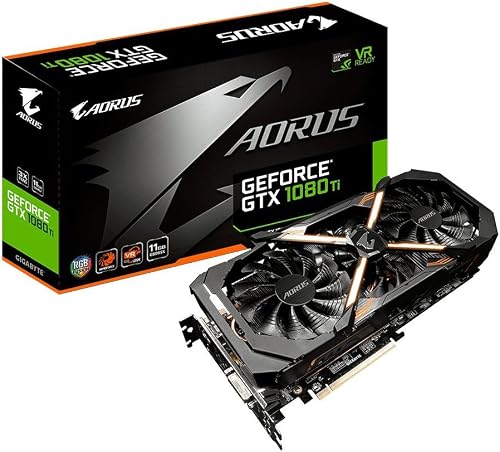
4. Gigabyte AORUS GeForce GTX 1080 Ti 11GB Graphic Cards GV-N108TAORUS-11GD
Best for: Users who want a card built with extra focus on durability and cooling.
This model features a stack of 100mm fans designed to move a large volume of air across the heatsink. It includes a metal backplate for structural protection and an advanced copper backplate for cooling. The clock speeds reach 1708 MHz in OC mode, which is helpful for those who need that extra boost in rendering software.
The build quality emphasizes both aesthetics with RGB Fusion and long-term hardware protection. It isn’t for users who are space-constrained, as the triple-fan cooling system adds significant length to the card.
Good if:
- You want a protective metal backplate for structural support.
- You need higher boost clock speeds for intensive tasks.
- You want 16.8 million customizable colors for your setup.
Skip it if:
- You have a small form factor PC.
- You don’t need extra copper backplate cooling.
5. ASUS GeForce GTX 1080 TI 11GB Turbo Edition VR Ready

Best for: First-time builders or those using smaller, compact PC cases.
The Turbo design is made to fit into tighter spaces where larger cards with multiple fans might struggle to fit. It uses a blower-style fan to push hot air directly out of the back of the case. This helps keep the internal temperature of the case lower, which is useful when other parts are also generating heat.
The construction uses Auto-Extreme technology and aerospace-grade components for reliability. It isn’t for someone looking for the absolute lowest noise levels, as blower fans can be louder than open-air designs when under heavy load.
Good if:
- You need a compact card for a small case.
- You want to exhaust hot air directly out of the chassis.
- You need a reliable build with high-quality components.
Skip it if:
- You require the quietest possible fan operation.
- You’re looking for a massive triple-fan aesthetic.
6. PNY GeForce GTX 1080 Ti 11GB Blower Design (VCGGTX1080T11PB-CG2) Graphic

Best for: Users who want a standard, no-frills blower design for their workstation.
This card follows the NVIDIA reference PCB, making it a predictable choice for those who want a standard layout. The blower design is efficient for cases where airflow management is difficult, as it pushes air out the back. It’s marketed as being significantly faster than the standard GTX 1080, providing a clear performance jump.
Because it uses a reference design, it’s compatible with a wide range of water blocks and aftermarket cooling solutions. It isn’t for users who want fancy RGB lighting or extra aesthetic features, as it focuses entirely on the core hardware.
Good if:
- You prefer a standard, reference-style PCB.
- You need a blower design to manage case heat.
- You want a straightforward performance increase.
Skip it if:
- You want customizable RGB lighting.
- You’re looking for a unique visual design.
7. MSI Gaming GeForce GTX 1080 8GB GDDR5X SLI DirectX 12

Best for: Users who need a solid 8GB card for general 3D work and rendering.
This card offers 8GB of GDDR5X memory, which is plenty for many medium-sized rendering tasks. It supports multiple monitors and high resolutions, making it flexible for a multi-screen workspace. The cooling system is designed to be efficient while maintaining a balance between performance and noise.
It requires both a 6-pin and an 8-pin power connector, so check your power supply before installation. It isn’t for users who specifically require the 11GB of VRAM found on the Ti models for massive, complex scenes.
Good if:
- You have a multi-monitor rendering setup.
- You want a card with a proven, balanced cooling design.
- You need support for a wide range of display outputs.
Skip it if:
- You need more than 8GB of video memory.
- You want the latest Ti-level performance.
8. NVIDIA GTX 1080 Ti FE

Best for: Those who want the original, authentic Founders Edition experience.
The Founders Edition is the baseline for the GTX 1080 Ti series. It’s built to the standards set by the manufacturer, offering a compact, solid frame that fits well in most systems. It’s a no-nonsense card that delivers the performance expected from the 1080 Ti chip without extra modifications.
Good if:
- You want the original design as intended by the manufacturer.
- You need a standard, reliable card for your build.
- You prefer a professional, understated look.
Skip it if:
- You want to push for the highest possible overclock.
- You require extra cooling features for long renders.
9. Nvidia GeForce GTX 1080 8GB FE Founders Edition GDDR5X Video

Best for: Users who need a reliable 8GB card for light rendering.
This is the standard Founders Edition of the GTX 1080. It provides 8GB of memory and is smaller than many of the newer, bulkier custom cards. It’s a compact option for those who don’t need the extra power of the Ti series but still want solid NVIDIA performance.
This card is not designed for professional, high-end 3D animation workloads that demand 11GB of VRAM for handling large textures and complex geometry.
Good if:
- You need a compact card that fits in almost any system.
- You want a reliable, standard card for general tasks.
- You don’t need the extra VRAM of a Ti model.
Skip it if:
- You work with very large or complex 3D scenes.
- You’re looking for high-end overclocking headroom.
Best Blender tile size for Nvidia 1080
Most of these cards share the same core architecture, meaning the raw rendering power in Blender will be similar across the 1080 Ti models. The real differences lie in the cooling systems, physical size, and power requirements. If you have a large case and good airflow, the choice between the EVGA FTW3 and the ASUS ROG Strix mostly comes down to your preference for fan control or sensor monitoring. For those with smaller cases, the blower-style cards like the ASUS Turbo or the PNY are nearly identical in function, and the choice between them should be based on availability and personal brand preference.
Still Not Sure?
How often will I really render?
If you render every day, you need a card with robust cooling like the EVGA FTW3 or the ASUS ROG Strix to prevent thermal throttling. If you only render occasionally, the standard Founders Edition or the MSI Gaming X will perform well enough without needing the extra cooling hardware.
What do I already own that this must work with?
Check your power supply and case size first. If you have a 600-watt supply and a small case, the ASUS Turbo 1080 Ti is a safe bet. If your case is large and you have a high-wattage power supply, you can consider the triple-fan Gigabyte AORUS 1080 Ti.
What am I most likely to regret choosing?
Most users regret choosing a card that’s too large for their case or too power-hungry for their current supply. If you’re unsure about your technical setup, sticking to the standard NVIDIA GTX 1080 Ti FE is a safe way to ensure compatibility and consistent performance for graphics card standards.
Frequently Asked Questions
Does the tile size in Blender change depending on my GPU?
Yes, using a smaller tile size is often better for GPU rendering. While older versions of Blender favored larger tiles, modern versions work well with smaller ones to prevent memory overflow. You can adjust this in the performance settings to find the best balance for your specific card.
Will these cards fit in any standard desktop case?
Most of these cards fit in standard ATX cases, but the triple-fan models like the ASUS ROG Strix and Gigabyte AORUS are much longer than others. Always check the interior clearance of your case and the card dimensions provided in the listing to ensure there’s enough room for installation.
Do I need extra power connectors for these graphics cards?
Yes, most of these cards require dedicated PCI-E power cables from your power supply. Most 1080 Ti models need both a 6-pin and an 8-pin connector. Verify that your power supply has these cables available before you buy, as using adapters can sometimes cause stability issues during long renders.
Is the refurbished status a concern for professional work?
Certified refurbished cards undergo testing and cleaning to ensure they work like new. As long as you purchase from a reputable seller, these cards should perform reliably. They often come with a warranty, which provides some security, but ensure you test the card immediately upon arrival to confirm it meets your needs.
Conclusion
For most users, the choice comes down to the physical constraints of their system and the intensity of their rendering tasks. If you have the space, the EVGA GTX 1080 Ti FTW3 offers great performance for heavy users, while the ASUS Turbo 1080 Ti is the best fit for compact builds. Check your case dimensions and power supply capacity today.