Finding the best blender tut for game design depends on your current skill level and the specific game engine you plan to use. There’s no single guide that fits every developer, as the workflow changes significantly depending on whether you’re building for Unity, Godot, or Unreal Engine. Your choice should be based on your preferred target platform and your need for either broad fundamentals or specialized technical skills. If you’re a newcomer to the software, start with a beginner-focused manual, while experienced artists should look toward engine-specific integration guides.
As an Amazon Associate, we earn from qualifying purchases. This post contains affiliate links – if you buy through them, we may earn a commission at no extra cost to you.
1. Game Asset Creation Blender
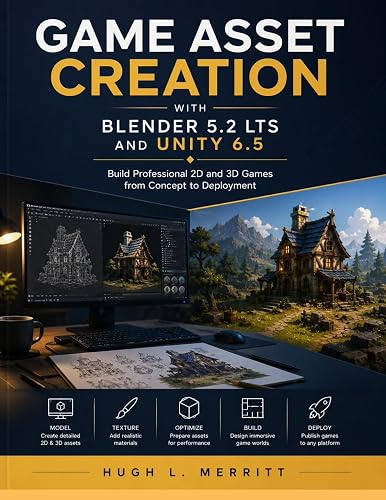
Best for: Developers focusing on Unity-based 2D and 3D game projects.
This guide is built to bridge the gap between initial concept art and final deployment in Unity 6.5. It focuses on the specific needs of game assets, which often require different optimization techniques than general 3D art.
It isn’t for someone who wants to learn general 3D modeling for animation or architectural visualization. The content is strictly limited to the game development pipeline.
Good if:
- You’re already committed to the Unity engine.
- You need a project-based approach for game assets.
- You want to follow a specific version (5.2 LTS).
Skip it if:
- You’re looking for a general-purpose manual.
- You prefer working with Unreal Engine or Godot.
2. Blender and Godot Development

Best for: Users building point-and-click adventure games using the Godot engine.
This title addresses the unique integration requirements of Godot. It helps you leverage the combined power of both tools to create a cohesive workflow for adventure-style mechanics.
It isn’t for developers building high-fidelity, first-person shooters or complex 3D simulations. The scope is narrow and focused on a specific genre.
Good if:
- You have chosen Godot as your primary engine.
- You’re interested in adventure game design.
- You want to see how these two tools communicate.
Skip it if:
- You need a broad overview of 3D modeling.
- You’re working with professional industry-standard engines like Unreal.
3. Production Ready Game Assets

Best for: Technical artists who want to master high-end sculpting and texturing.
This guide teaches the professional pipeline using ZBrush, Blender, and Unreal Engine 5. It covers the demanding workflows required for real-time rendering in modern game environments.
It isn’t for beginners who have never touched 3D software. The inclusion of ZBrush suggests a high level of complexity that may overwhelm a new user.
Good if:
- You aim for a career in professional game studios.
- You need to understand real-time rendering workflows.
- You’re comfortable with multiple software packages.
Skip it if:
- You’re just starting your journey in 3D.
- You have no interest in professional-grade sculpting tools.
4. Character Rigging for Games

Best for: Artists who want to specialize in the technical side of animation.
Character rigging is a specific skill that determines how a model moves in a game. This guide provides a complete walkthrough of the process within Blender to ensure your characters are game-ready.
It isn’t for someone who wants to focus on environment design or level creation. The topic is very narrow and technical.
Good if:
- You want to animate characters for your games.
- You need to understand deformation and bone weights.
- You want to improve your character movement.
Skip it if:
- You’re primarily interested in static environmental assets.
- You find technical rigging concepts too dry.
5. 3D Environment Design with Blender 5

Best for: World builders who need to improve their modeling and lighting skills.
This book focuses on the artistry of creating realistic 3D scenes. It emphasizes the techniques used to make environments look immersive and professional for game projects.
This guide is not intended for developers seeking to master game logic or character animation, as it focuses exclusively on the visual aspects of game design.
Good if:
- You enjoy building levels and exterior scenes.
- You want to focus on lighting and texturing.
- You need better modeling skills for landscapes.
Skip it if:
- You want a guide that includes game engine integration.
- You’re more interested in character design.
6. 3D Game Development with Blender 5 and Unity 6

Best for: Creators who want a real-time, elegant workflow between Blender and Unity.
This guide focuses on the immersive nature of 3D game development. It’s designed to help you maintain a clean, efficient workflow while moving assets between Blender 5 and Unity 6.
It isn’t for hobbyists who just want to make single models. The focus is on the complete development cycle for immersive worlds.
Good if:
- You value a smooth, efficient software workflow.
- You’re building 3D games in Unity.
- You want to create detailed, immersive environments.
Skip it if:
- You prefer Godot or Unreal Engine.
- You aren’t interested in the technical side of asset management.
7. Blender 5.1 Mastery Guide

Best for: Students who learn best by building real-world projects.
This guide takes a step-by-step approach to the interface, lighting, and animation. By building a perpetual motion loop, you learn how the different tools interact in a practical scenario.
It isn’t for someone who wants a quick reference manual to look up specific features. The project-based structure requires you to follow the whole path.
Good if:
- You like learning by doing rather than reading theory.
- You want to master the interface and animation.
- You’re a visual learner.
Skip it if:
- You want to jump directly into game engine integration.
- You prefer a dictionary-style reference guide.
8. Blender 5.2 User Guide

Best for: Power users who want one book that covers everything.
This is a comprehensive manual that touches on modeling, sculpting, geometry nodes, and video editing. It’s intended to be a long-term reference for your professional workflow.
It isn’t for someone who wants a light, casual introduction to 3D. The sheer volume of information can be intimidating for a brand-new user.
Good if:
- You want a single reference for all your needs.
- You use advanced features like geometry nodes.
- You’re serious about professional 3D work.
Skip it if:
- You find big manuals overwhelming.
- You only need basics for simple game assets.
9. Blender 5.0 Beginner Guide

Best for: Absolute beginners who have zero experience in 3D software.
This guide focuses on getting you from scratch to your first complete project. It covers the basics of modeling, texturing, and animation without using confusing jargon.
It isn’t for experienced artists who already know the basics of 3D modeling. You may find the pacing too slow.
Good if:
- You have never opened 3D software before.
- You want to create your first render quickly.
- You need clear, simple instructions.
Skip it if:
- You have previous experience with other 3D software.
- You’re looking for advanced game development techniques.
10. Mind-Melding Unity and Blender for 3D Game Development

Best for: Developers who want to master the connection between Unity and Blender.
This book looks at how to unleash the power of both tools together. It focuses on the specific integration points that make game development easier and more effective.
It isn’t for someone who isn’t using Unity. The specific focus on Unity makes it less useful for Godot or Unreal users.
Good if:
- You want to improve your Unity and Blender workflow.
- You’re looking for ways to create better games.
- You want to see how these two tools “meld” together.
Skip it if:
- You’re using a different game engine.
- You want to focus on standalone 3D art.
Best Blender Game Design Tutorials
Many of these guides cover the same core Blender fundamentals, such as modeling, texturing, and interface navigation. If you choose between the general manuals, like the 5.1 Mastery Guide or the 5.2 User Guide, the difference often comes down to your preferred learning style—project-based versus reference-based. However, the game-specific titles are genuinely different because they cater to the unique export and import requirements of specific engines like Unity, Unreal, or Godot. Choosing the right one is less about the quality of the Blender instruction and more about whether the book includes the specific engine integration you need. If you have already picked an engine, prioritize the title that covers that specific tool.
Still Not Sure?
How often will I really use it?
If you plan to make game design your daily focus, you should choose a comprehensive manual like the Blender 5.2 User Guide. It serves as a long-term reference. If you only intend to finish one or two small projects, a project-based book like the Blender 5.1 Mastery Guide will be more useful.
What do I already own?
If you’re starting from zero with no software, the Blender 5.0 Beginner Guide is your best start. You should align your learning materials with the engine you’re most comfortable using.
What am I most likely to regret?
You’ll regret choosing a specialized book for an engine you don’t actually intend to use. If you want to use Unreal Engine, don’t buy a book focused on Unity. Always check that the guide matches your chosen engine, as Blender Foundation documentation highlights how complex 3D integration can be across different platforms.
Related guides
- 10 Best Blender 3D Modeling Practice Books for Beginners
- 10 Best Blender 3D Modeling Practice Books for Beginners
- 10 Best Game Engines for Blender: Top Picks for Your Projects
Frequently Asked Questions
Which blender tut for game design is best for Unity users?
Game Asset Creation Blender and Mind-Melding Unity and Blender are the top choices for Unity developers. Both titles focus on the specific pipeline between Blender and the Unity engine, helping you optimize assets for real-time performance. Choose based on whether you want a broad overview or a focus on asset creation.
Can I use these guides for other 3D software?
Most of these guides are specific to Blender and its unique interface and node systems. While the artistic principles of modeling and texturing carry over to other programs, the button-by-button instructions won’t apply to Maya or 3ds Max. Stick to Blender-specific titles if you’re learning the software.
Do I need to be good at math for these guides?
You don’t need to be a mathematician, though basic geometry helps with modeling. Guides like the Blender 5.0 Beginner Guide focus on visual workflows rather than complex math. If you want to learn about geometry nodes, the latest long-term support version of the Blender User Guide includes them as a covered topic.
How do I know if my computer can handle these projects?
The listing doesn’t mention hardware requirements. Check your system against the official requirements for your chosen game engine, such as Unity or Unreal, as these will likely be the limiting factor for your performance during development.
Conclusion
If you’re a beginner, start with the Blender 5.0 Beginner Guide to build your confidence. If you already have an engine in mind, choose the guide that matches your specific platform, such as the titles for Unity or Unreal. Check your engine’s requirements, pick your path, and start your first project today.