As an Amazon Associate, we earn from qualifying purchases. This post contains affiliate links, and buying through one costs you nothing extra.
Finding the right tool for physics simulation depends on your specific goals, existing hardware, and technical background. For heavy AI development, the NVIDIA DGX Spark and AMD Ryzen AI Halo lead the field, while the United Scientific Shake Table is the standard for physical structural testing.
1. Physical AI Simulation Platform

Best for: Developers needing a reliable, dedicated environment for AI-driven physical modeling.
This platform is intended for users who require a consistent space to run AI simulations without the need for custom hardware assembly. It provides a stable foundation for those focused on the software side of physics and AI interaction.
The platform is built to handle intensive tasks, allowing you to focus on your code rather than system maintenance. It isn’t for someone who prefers to build their own custom server from individual components, as it’s designed as a pre-configured solution for specific AI workloads.
Good if:
- You want a dedicated platform for AI physics.
- You need a stable, pre-built environment.
- You’re focused on software development.
Skip it if:
- You prefer to hand-pick every hardware component.
- You have a very limited workspace for desktop gear.
2. Plataforme Travaux Pratiques Physique

Best for: Educators looking to digitize physics laboratory experiments for students.
This virtual laboratory environment allows users to replicate physical phenomena in a digital space. It’s designed to bridge the gap between theoretical physics and practical, repeatable results without needing a physical lab space.
It suits educational settings where students need to observe variables in a controlled, safe, and virtual environment. It isn’t for researchers who require physical motion hardware or high-end GPU acceleration for massive machine learning datasets.
Good if:
- You teach physics in a digital classroom.
- You need a safe way to show experiments.
- You want to repeat tests without physical setup.
Skip it if:
- You need to test real-world structural vibrations.
- You’re performing high-level AI model training.
3. Next Level Racing Motion Platform v3 (NLR-M001V3)

Best for: Users building a professional-grade motion racing or flight simulator.
This hardware moves the seat to create a realistic sense of speed and terrain. It’s designed in collaboration with commercial motion engineers to provide smooth, high-end motion cues for racing and flight enthusiasts.
Its compact design allows it to fit into existing cockpits, making it useful for those who want professional movement without needing a massive dedicated room. It isn’t for users who only want visual simulation, as this is purely a mechanical hardware addition.
Good if:
- You already own a racing or flight cockpit.
- You want professional-grade motion cues.
- You need a compact, powerful motion system.
Skip it if:
- You’re building a purely software-based AI model.
- You don’t have a seat or frame to attach it to.
4. Next Level Racing Motion Plus Platform NLR-M007

Best for: Enthusiasts wanting precise, modular motion feedback during simulations.
This platform uses modular units to allow for different degrees of freedom, from 2-DOF to 3-DOF. It focuses on low-latency movement, ensuring that the chassis reacts sharply to every bump or turn in your software.
The system is highly adaptable, fitting into existing ecosystems to customize the feel of your simulation. It isn’t for a user looking for an all-in-one computer or a simple educational tool, as this requires a specific setup of racing or flight gear to be useful.
Good if:
- You want to customize your degree of motion.
- You need ultra-low latency movement.
- You’re expanding an existing motion setup.
Skip it if:
- You’re a beginner with no prior simulation hardware.
- You’re looking for a standalone AI developer platform.
5. United Scientific™ Earthquake Vibration Table

Best for: STEM students investigating structural integrity under seismic conditions.
This table creates horizontal and vertical vibrations to test how tower models hold up during an earthquake. It’s a physical tool designed for hands-on learning, providing a clear demonstration of how base designs affect structural survival.
The device is simple to operate, allowing students to adjust power and test their designs repeatedly. It isn’t for those needing digital AI simulation or motion racing platforms, as this is strictly a mechanical tool for engineering education.
Good if:
- You’re teaching structural engineering or physics.
- You need a hands-on, physical vibration test.
- You want to test tower models up to 12 inches.
Skip it if:
- You’re looking for software or AI development tools.
- You need high-speed data recording.
6. AMD Ryzen AI Halo

Best for: Developers building and running large AI models locally.
This platform is a powerful desktop built specifically for local AI development. It features 128GB of unified memory and a high-bandwidth pool, which is essential for working with large parameters and intensive AI workloads.
It comes pre-configured with Linux and AMD ROCm software, helping developers get started quickly. It isn’t for the average home user who just wants a general-purpose computer, as the specs are highly specialized for intensive local AI inference.
Good if:
- You need local AI model development.
- You require 128GB of unified memory.
- You prefer a Linux-based developer platform.
Skip it if:
- You’re a casual user looking for basic office software.
- You need physical motion hardware for a cockpit.
7. NVIDIA DGX Spark

Best for: Professionals requiring petaFLOP-scale AI performance on a desktop.
This is a compact supercomputer designed to bring enterprise-grade AI performance directly to a workspace. It uses the Grace Blackwell architecture to handle large models and rapid fine-tuning.
It’s ideal for prototyping and high-performance computing tasks that usually require cloud resources or data centers. It isn’t for someone with a small budget or simple needs, as this is a high-performance machine built for specific, heavy-duty AI development.
Good if:
- You need enterprise-scale AI performance.
- You’re prototyping large-scale models locally.
- You need to fine-tune AI models quickly.
Skip it if:
- You’re a beginner in STEM or basic coding.
- You only need simple physical vibration testing.
8. UNIHIKER K10 AI Coding Board

Best for: Beginners and STEM students starting their AI and IoT journey.
This all-in-one board includes a camera, microphone, and display, making it perfect for learning how AI interacts with the physical world. It supports drag-and-drop coding, which lowers the barrier to entry for someone new to machine learning.
It’s a great way to experiment with TinyML and vision AI without needing complex servers. It isn’t for advanced users who need to run massive, 200B parameter models, as its hardware is designed for educational projects and prototyping.
Good if:
- You’re a beginner in AI and IoT.
- You want an all-in-one learning device.
- You like graphical or MicroPython coding.
Skip it if:
- You need to run large-scale enterprise AI models.
- You’re building a professional racing cockpit.
9. NVIDIA Jetson AGX Orin 64GB Developer Kit with Ethernet
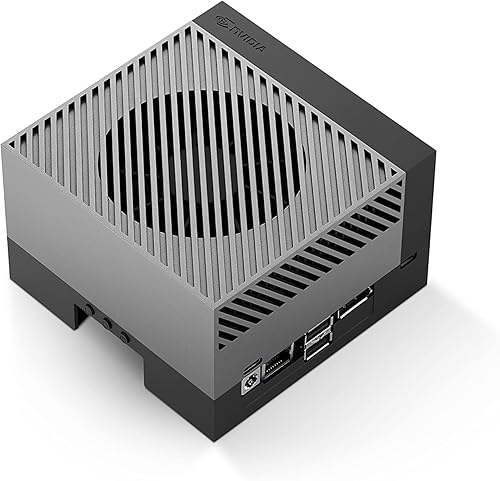
Best for: Prototyping advanced autonomous machines and robots.
This developer kit is designed to handle multiple concurrent AI pipelines, such as natural language understanding and 3D perception. It provides significant computing capability in a compact form, perfect for those building the next generation of robots.
It runs the standard NVIDIA AI software stack, ensuring compatibility with tools like Isaac for robotics. It isn’t for someone who just wants to learn the basics of coding, as it’s a powerful piece of hardware aimed at developers building autonomous solutions.
Good if:
- You’re developing autonomous robots.
- You need multi-sensor fusion capability.
- You use the NVIDIA AI software stack.
Skip it if:
- You’re a complete beginner to programming.
- You’re looking for a desktop for general AI training.
10. NVIDIA Jetson Orin Nano Super Developer Kit

Best for: Creating entry-level AI robots and intelligent cameras.
The Orin Nano is an accessible platform for those who want to start building smart drones or cameras. It offers a massive performance jump over the older Jetson Nano, allowing it to run modern transformer models.
It’s a great choice for prototyping edge AI products that need to be compact and efficient. It isn’t for users who need to train massive models from scratch, as it is designed for high-performance inference at the edge.
Good if:
- You’re building entry-level AI robots.
- You need a compact edge AI platform.
- You want to run modern transformer models.
Skip it if:
- You need the power of an AGX-level system.
- You’re only interested in structural engineering tests.
Where These Overlap
The NVIDIA Jetson AGX Orin and the Jetson Orin Nano overlap significantly in their ecosystem support, as both rely on the NVIDIA AI software stack and the Isaac framework. If you’re developing robotics, the choice between them is purely about the scale of your project: the AGX Orin is for complex, multi-sensor autonomous systems, while the Orin Nano is for lighter, entry-level edge AI. Similarly, the AMD Ryzen AI Halo and NVIDIA DGX Spark are both high-end desktop platforms for local AI, but they differ in their specific chip architecture and software optimization. Choose based on whether your current workflow is tied to AMD ROCm or the NVIDIA software stack.
Still Not Sure?
How often will I really use this for simulation?
If you’re a student or hobbyist, you might use your equipment sporadically for specific projects or classes. In this case, choose a platform that’s easy to set up and put away, like the UNIHIKER K10 Board. If you’re a professional, you’ll likely use it daily, making the NVIDIA DGX Spark a better long-term choice.
What hardware do I already own?
If you already have a racing cockpit, adding a Next Level Racing V3 is a natural step to increase immersion. However, if you’re starting from zero and want to explore physics or AI, look at the United Scientific Shake Table for engineering or the NVIDIA Jetson Orin Nano for robotics.
What am I most likely to regret choosing?
Regret usually comes from buying too much or too little power. If you buy a massive supercomputer like the NVIDIA DGX Spark for simple school projects, you’ll waste resources. If you buy the entry-level UNIHIKER K10 Board for professional enterprise AI development, you’ll quickly hit a wall. Pick the tool that matches your current skill.
Related guides
- Can I Drink Ground Coffee Safely? Here Is the Verdict
- Is Medium Roast Coffee Healthy? The Nutritional Verdict
- 10 Best Caustics Engines for Blender: Our Expert Verdict
Frequently Asked Questions
Which platform is best for testing structural physics?
The United Scientific Shake Table is specifically designed for structural engineering and earthquake vibration testing. It uses corner springs and dual motors to replicate horizontal and vertical motion, allowing students to test building models up to 12 inches. It’s a dedicated mechanical tool, not a software-based AI simulation platform.
Can I use these AI platforms for general physics research?
Yes, platforms like the NVIDIA DGX Spark or AMD Ryzen AI Halo provide the computational power required for complex physical modeling and simulation. By using software like Python Physics Simulations, you can leverage the unified memory and high-performance hardware to run intensive calculations that aren’t possible on standard home computers.
What software is compatible with the motion platforms?
The Next Level Racing V3 and Next Level Racing Plus are compatible with all major racing and flight titles on PC. They use dedicated software to manage motion cues, and they’re designed to plug in via USB, making them simple to integrate into your existing simulator setup for enhanced immersion.
Is the NVIDIA Jetson series suitable for beginners?
The NVIDIA Jetson Orin Nano is an ideal starting point for beginners exploring AI-powered robotics and intelligent cameras. It simplifies setup while providing sufficient performance to run modern AI models. While excellent for these applications, users seeking foundational coding education may prefer the UNIHIKER K10 Board.
Closing
Choosing the right platform depends on your primary goal: educational engineering, motion immersion, or professional AI development. If you need physical structural testing, the United Scientific Shake Table is your best bet, while those focused on high-end AI development should look at the NVIDIA DGX Spark. Check the specifications for your specific project needs before purchasing.