As an Amazon Associate, we earn from qualifying purchases. This post contains affiliate links, and buying through one costs you nothing extra.
Finding the best programs for artwork augmented reality blender projects depends on your specific goals and skill level. Choosing between the Blender 5.2 Project Method for hands-on practice and the broader, more technical Blender 5.2 Complete Manual will split most buyers.
1. Blender 5.2 Project Method

Best for: Students wanting to build a job-ready portfolio quickly.
This guide focuses on practical application rather than theory. By working through ten real-world projects, you learn how to solve problems that come up in professional workflows. It’s designed to get you out of “tutorial hell” by forcing you to apply what you learn immediately.
If you’re looking for a deep dive into every single tool icon in the software, this might not be your primary choice. It moves fast, assuming you want to build assets that look good in a portfolio right away. It’s perfect for someone who learns best by doing.
Good if:
- You have a 30-day window to learn.
- You need to build a professional portfolio.
- You prefer active project work over reading.
Skip it if:
- You’re a total beginner who needs slow, step-by-step explanations.
- You’re looking for a reference book to keep on your desk.
2. 3D Game Development with Blender 5 and Unity 6

Best for: Developers building immersive 3D games.
This book bridges the gap between 3D modeling and game engine implementation. It covers the workflow needed to move assets from the blender environment into Unity. If your end goal is interactive 3D content, this is the most relevant path.
The trade-off is that it focuses heavily on game-ready assets rather than general artistic sculpting or animation. It isn’t for someone who just wants to make static art for social media. If you aren’t planning to use a game engine, you’ll find many chapters here that don’t apply to your work.
Good if:
- You want to see your art move in a game.
- You’re interested in real-time workflows.
- You’re already familiar with basic modeling.
Skip it if:
- You have no interest in game development.
- You’re looking for general artistic training.
3. Blender Metaverse Asset Creation

Best for: Creators designing avatars and virtual world objects.
This focuses on the specific requirements of metaverse platforms. It covers the creation of characters and models that need to function within virtual environments. This is a niche pick for those who want to build digital identities or tradeable assets.
The focus here is on efficiency and compatibility, which means it might skip some of the more artistic or advanced rendering techniques found in general guides. It isn’t for the hobbyist who just wants to make beautiful, complex scenes for their own enjoyment.
Good if:
- You want to build avatars for virtual worlds.
- You’re interested in digital asset creation.
- You want to learn about metaverse-specific standards.
Skip it if:
- You want to focus on high-fidelity cinematic rendering.
- You aren’t interested in avatar-based art.
4. 3D Environment Design with Blender 5

Best for: Artists building detailed 3D scenes.
This guide centers on the skills needed for modeling, texturing, and lighting, which are the pillars of environment design. It helps you create believable, realistic spaces. It’s ideal for someone who wants to focus on building entire worlds rather than single objects.
Because it’s so focused on environments, it may not cover character rigging or advanced animation in the detail some users expect. If you want to focus on character art, you’ll find this guide lacks the specific instruction you need for armatures and weight painting.
Good if:
- You want to focus on lighting and texturing.
- You enjoy building complex, realistic scenes.
- You want to improve your modeling skills.
Skip it if:
- Your main interest is character art.
- You want to learn about game logic or coding.
5. Blender Rigging Made Simple

Best for: Animators focusing on character movement.
Rigging is often the hardest part of the 3D process for beginners. This book simplifies armatures, weight painting, and inverse kinematics (IK) to make character animation accessible. It breaks down the technical setup required to make characters move naturally.
The tradeoff is that it’s very technical and focused on the “bones” of the model. If you aren’t interested in animation and only want to make static sculptures, the content here will be more than you need. It isn’t for the designer who ignores the internal structure of their art.
Good if:
- You want your characters to move.
- You struggle with weight painting and IK.
- You’re a beginner in character animation.
Skip it if:
- You only care about static 3D modeling.
- You’re already advanced in rigging.
6. Realizing 3D Animation in Blender

Best for: Beginners learning the fundamentals of animation.
This book covers the basics of keyframing and character movement. It’s a great starting point for anyone who wants to learn how to make their models move. It provides a solid foundation for those who are new to the animation timeline.
It doesn’t go into the advanced rigging or physics simulations that a professional studio might use. If you’re already an intermediate user looking for high-end animation secrets, you might find the pace a bit too basic. It’s meant for those taking their first steps in movement.
Good if:
- You’re brand new to 3D animation.
- You want to understand keyframing basics.
- You need a clear, structured learning path.
Skip it if:
- You’re looking for advanced physics simulation.
- You have significant experience in other software.
7. Blender 5.2 Complete Manual

Best for: Users who want a single, comprehensive reference book.
This is the “everything” guide. It covers modeling, animation, sculpting, rendering, and even video editing. It’s the best choice for someone who wants one book that covers all the bases without needing to buy multiple titles later.
The sheer volume of information can be overwhelming for a complete newcomer. Because it covers so much, it can’t go as deep into any one topic as a specialized guide. It isn’t for someone who wants a quick, focused project-based experience.
Good if:
- You want one book for every feature.
- You like having a reference manual nearby.
- You plan to use many parts of the software.
Skip it if:
- You’re easily overwhelmed by large manuals.
- You only want to focus your learning on a single specific skill.
8. Blender 5.1 Mastery Guide

Best for: Learners who appreciate a step-by-step approach.
This guide focuses on building real projects while mastering the interface, lighting, and materials. It includes a specific project on a perpetual motion loop, which helps tie all the skills together. It’s a very balanced approach to learning.
While it’s very thorough, it’s tied to version 5.1, so you might notice small interface differences if you’re using the very latest software version. It isn’t for the person who needs the most up-to-date documentation on every new feature or experimental node.
Good if:
- You like building specific, structured projects.
- You want to understand materials and lighting.
- You prefer a step-by-step learning style.
Skip it if:
- You require the absolute latest version details.
- You prefer reference manuals over project guides.
9. Blender 5.0 Sculpting Guide

Best for: Artists interested in digital sculpting.
This guide focuses on the artistic side of 3D modeling. It teaches you how to sculpt, texture, and animate from scratch. It’s great for those who want to create organic shapes and characters without needing prior technical experience.
Because it focuses on sculpting, it doesn’t spend much time on complex game assets or advanced video editing. If your goal is to be a technical director or a game developer, you’ll find this guide lacks the depth you need for those specific pipelines.
Good if:
- You want to focus on digital sculpting.
- You have no prior 3D experience.
- You want to create organic art.
Skip it if:
- You want to focus on technical game assets.
- You’re already an experienced 3D modeler.
10. Blender 5.2 Visual Guide
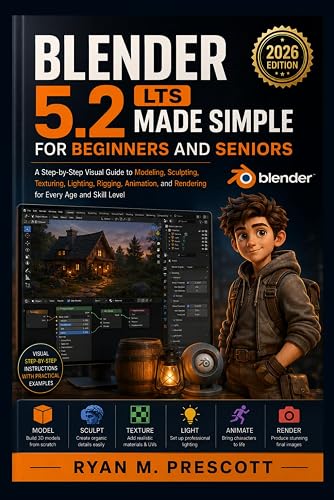
Best for: Visual learners and seniors.
This book uses a visual approach to teach modeling, sculpting, and rigging. The layout is designed to be easy to follow for any age or skill level. If you find text-heavy manuals difficult, this visual guide will be much easier to navigate.
The visual format may sacrifice some of the dense, technical detail found in more traditional manuals. It isn’t for the user who wants a deep, academic understanding of every single geometry node or complex simulation setting. It’s designed for clarity and ease of use.
Good if:
- You learn better with pictures and diagrams.
- You’re a beginner looking for clear steps.
- You want a guide that’s easy to read.
Skip it if:
- You want a deep dive into complex technical nodes.
- You prefer dense, text-based technical documentation.
Best Programs for Blender and Augmented Reality Artwork
Many of these titles share a similar goal: helping beginners transition into 3D creation. The guides for beginners, such as the visual guide and the sculpting guide, overlap significantly in their early chapters. They all start with the interface and basic modeling. If you’re a total beginner, any of these will give you a strong start. The differences only become clear when you decide whether you want to focus on characters, environments, or game assets. If you’re choosing between two beginner guides, the decision usually comes down to whether you prefer a visual layout or a project-based approach. The content is similar, but the teaching style is what separates them.
Still Not Sure?
How much time can I realistically commit?
If you have a limited window, you should choose a project-based guide that gets you to a result quickly. The Blender 5.2 Project Method is built for those who need to see progress immediately. If you have months to learn, a broader manual will serve you better in the long run.
What is my end goal for this art?
If you want to work in game development, you need a guide that covers integration, like the Blender 5 Unity Integration. If you just want to make beautiful, static art for your own portfolio, you should look at the Blender 5.2 Visual Guide or the Sculpting Guide instead.
Will I regret choosing a specialized guide?
If you choose a guide that’s too narrow, you might feel stuck when you want to try something new. If you are worried about this, the comprehensive manual is the safest choice. It covers everything, so you won’t regret picking something that lacks the features you discover later.
If you want a portfolio quickly, pick the project-based method for its hands-on approach. If you want a complete reference for all your future projects, choose the Blender 5.2 Complete Manual. Start by identifying your primary goal, then match it to the guide that emphasizes that skill set.
Frequently Asked Questions
Is it hard to learn 3D modeling if I have no experience?
Learning 3D modeling is a process that requires patience, but many beginners succeed by following structured, step-by-step guides. The visual guide is specifically designed for beginners who need a clear, non-intimidating start. Consistency is key, and completing a single, full project helps you understand the interface much faster than reading alone.
Do I need a powerful computer for these projects?
Most basic 3D modeling and animation tasks can be done on standard hardware, but high-fidelity rendering or complex simulations will benefit from more powerful specifications. The official website provides the minimum hardware requirements for the software to function correctly. The listing doesn’t mention system specs.
Can I use these books for older versions of the software?
While the core concepts of 3D art remain the same, interface layouts and tool locations often change between software versions. Using a guide written for an older version may cause minor confusion during setup. If you’re using version 5.2, it’s always better to pick a guide that specifically mentions that version to avoid frustration with updated menus.
Which guide is best for character animation?
If character animation is your main goal, you need a guide that covers rigging, such as Blender Rigging Made Simple. This book focuses on the technical side of making characters move, which is essential for any animator. Other general guides might touch on animation, but they often lack the depth needed to handle complex armatures and weight painting properly.
Conclusion
You don’t have to rush into a complex workflow right away. Start by downloading a simple plugin to test how your 3D models look in your real-world space. It’s a fun way to see your creations come to life, and you’ll quickly discover which tools feel most natural for your creative style.