
As an Amazon Associate, we earn from qualifying purchases. This post contains affiliate links – if you buy through them, we may earn a commission at no extra cost to you.
Choosing the {best gpu for redshift renderer} depends on your specific workflow, the size of your scenes, and whether you prioritize raw speed or massive memory capacity. Redshift scales well with more cores and faster VRAM, but different projects demand different hardware trade-offs. Some users require the massive buffer for complex geometry and high-resolution textures, while others need a compact card that fits into a standard workstation case. If you need maximum rendering throughput, the high-end Blackwell cards stand out, whereas professional-grade cards focus on stability and ECC memory support for long-running simulations.
1. NVIDIA RTX 6000 Blackwell

Best for: Professionals demanding the absolute highest performance for complex 3D rendering.
This card is designed for users who can’t afford bottlenecks in their rendering pipeline. With 96GB of GDDR7 memory, it handles massive 3D scenes and local AI fine-tuning without needing to offload data. The Blackwell architecture provides significant throughput increases, allowing for faster processing of complex scenes that would normally slow down lesser hardware.
The double-flow-through cooling design is built to sustain peak performance under 600W power loads. This card isn’t for users with small power supplies or limited chassis space, as it requires substantial power and room for cooling. The inclusion of ECC memory ensures that long, heavy renders maintain data integrity throughout the process.
Good if:
- You work with massive, multi-million polygon 3D scenes.
- You need to run complex generative AI models locally alongside rendering.
- You require the highest possible memory bandwidth for multi-app workflows.
Skip it if:
- You have a limited power supply or small PC case.
- You only work on small-scale projects where 96GB is overkill.
2. PNY NVIDIA RTX A6000

Best for: Artists who rely on stable, certified professional workstation hardware.
The RTX A6000 uses the Ampere architecture to provide reliable performance for photorealistic rendering and virtual prototyping. Its 48GB of VRAM offers a large workspace for complex geometry, and the ability to link two cards via NVLink allows you to scale up your memory if your project requirements grow.
The RTX A6000 is designed for professional workflows, including architectural design evaluations and virtual prototyping. It isn’t intended for users looking for the latest consumer gaming features, as its architecture focuses on professional-grade stability and simulation efficiency rather than the newest AI-driven frame generation tech.
Good if:
- You need a proven, stable card for commercial 3D production.
- You plan to scale your memory capacity using NVLink.
- You prioritize workstation-certified drivers for your primary software.
Skip it if:
- You want the latest Blackwell architecture features.
- You need the absolute highest memory bandwidth available today.
3. PNY NVIDIA RTX A5000 Professional Graphic Card 24GB GDDR6 PCI

Best for: Professionals who need a balance of VRAM and compact design.
The RTX A5000 provides 24GB of GDDR6 ECC memory. Its dual-slot design makes it easier to fit into tighter workstation builds compared to the larger, triple-slot enthusiast cards.
Because it uses the PCIe 4.0 interface, it’s highly compatible with a wide range of existing professional motherboards. While it lacks the massive VRAM headroom of the 6000-series, it’s a reliable choice for artists who need a dedicated professional card that stays cool and quiet under load.
Good if:
- You have limited space in your workstation case.
- You need ECC memory to prevent errors during long renders.
- You require a balance between VRAM capacity and overall power draw.
Skip it if:
- You regularly work with extremely large 8K assets.
- You want the fastest memory speeds available in newer generations.
4. ASUS TUF Gaming GeForce RTX™ 5080 16GB GDDR7 OC Edition
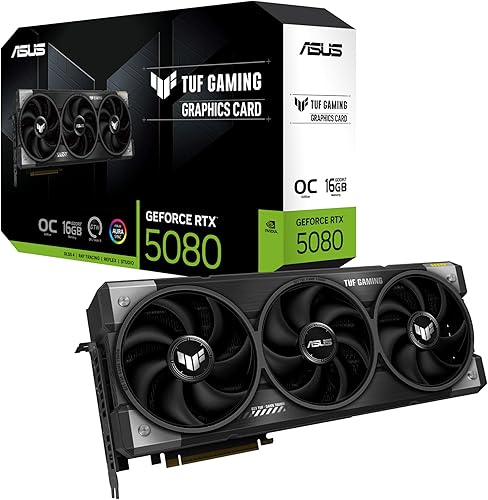
The RTX 5080 brings the latest Blackwell architecture to creators who want fast rendering and modern AI features. With 16GB of GDDR7 memory, it handles most standard 3D work efficiently. The triple-fan cooling system and phase-change thermal pads help keep temperatures stable during long rendering sessions.
This card is quite large, requiring 3.6 slots of space and a robust power supply. It’s designed for gamers and creators who want to leverage the latest AI-accelerated rendering tools in Redshift, but it lacks the ECC memory features found in the professional workstation lines.
Good if:
- You want the latest Blackwell architecture.
- You need fast rendering for standard-sized 3D projects.
- You prioritize modern thermal management features.
Skip it if:
- You have a small or cramped PC case.
- You require ECC memory for critical data stability.
5. PNY VCNRTXPRO2000B-PB NVIDIA RTX PRO 2000 Blackwell 16GB GDDR7 128B

Best for: Compact workstations where power efficiency is the top priority.
The RTX PRO 2000 is a specialized card for those who need professional features in a very small form factor. Its 70W power consumption makes it an excellent choice for builds that require efficient power management.
While it’s compact, it still provides the benefits of the Blackwell architecture. The listing doesn’t mention the specific rendering or data science capabilities of the RTX PRO 2000.
Good if:
- You’re building a very small, quiet workstation.
- You need low power consumption for your setup.
- You do mostly light 3D modeling and occasional rendering.
Skip it if:
- You need to render complex, high-poly scenes.
- You require a high VRAM capacity for large assets.
6. ASUS TUF Gaming GeForce RTX 5070 12GB GDDR7 OC EditionGaming

Best for: Mid-range creators who need a reliable, modern rendering workhorse.
The RTX 5070 offers a middle ground for artists who want the latest Blackwell performance without needing the high power requirements of the 5090 or 5080. It features 12GB of GDDR7 memory, which is sufficient for many common 3D workflows and rendering tasks.
The card includes robust build features like a protective PCB coating and a GPU guard to prevent sagging, which is helpful for long-term reliability. It isn’t meant for those working on massive cinematic productions where 24GB or more of VRAM is often necessary to avoid crashes.
Good if:
- You want a balance of performance and efficiency.
- You appreciate build features that protect the card from sagging.
- You use modern AI-assisted workflows.
Skip it if:
- You work with very large or complex scenes frequently.
- You need more than 12GB of VRAM for your projects.
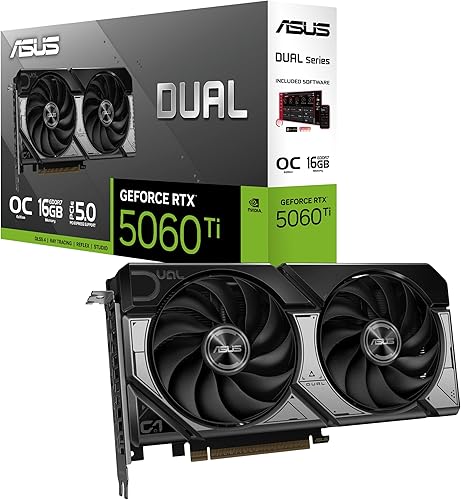
7. ASUS Dual GeForce RTX 5060 Ti 16GB GDDR7 OC Edition
Best for: First-time 3D artists or entry-level rendering setups.
The RTX 5060 Ti is a great entry point for those just starting with Redshift. It features 16GB of GDDR7 memory, which is surprisingly generous for this class of card, allowing for more complex scenes than you might expect.
The 2.5-slot design makes it very versatile for different PC cases. While it offers 767 AI TOPS for accelerated workflows, it’s still an entry-level card.
Good if:
- You’re just starting your 3D journey.
- You need a card that fits in a variety of PC cases.
- You want 16GB of VRAM at a more accessible level.
Skip it if:
- You’re a professional working on high-end, complex animations.
- You need the maximum possible render speed for tight deadlines.
8. ASUS TUF Gaming GeForce RTX 5090 Triple Fan GPU

Best for: Power users who want the absolute peak of modern consumer hardware.
The RTX 5090 is built for extreme productivity, featuring 32GB of GDDR7 VRAM and an massive 21,760 CUDA cores. It is designed for local LLM inference, on-device AI, and handling 8K assets.
This card is a monster in terms of size and power. It comes with a GPU holder to manage its weight, as sagging can be a significant issue for such a large component.
Good if:
- You need maximum VRAM for large-scale 3D projects.
- You frequently work with 8K assets and complex simulations.
- You want to run local AI models alongside your rendering.
Skip it if:
- You have a restricted power budget.
- You don’t have the physical space for a triple-fan flagship card.
9. NVlDlA RTX PRO 6000 Blackwell max-Q Workstation Ed. 96GB GDDR7

Best for: Large studios needing enterprise-grade reliability and high-speed memory.
This version of the RTX PRO 6000 Blackwell features a Max-Q design, which optimizes it for high-performance computing while keeping power consumption manageable. With 96GB of GDDR7 ECC memory, it’s effectively a powerhouse for studios that need to eliminate VRAM bottlenecks entirely.
The use of ECC memory is critical for enterprise environments where data accuracy is a primary requirement. While it fits in standard desktops, its enterprise-focused feature set might be more than the average freelancer needs, and it lacks the retail packaging found in consumer editions.
Good if:
- You work in an enterprise or research lab environment.
- You need 96GB of ECC memory for critical projects.
- You want high performance within a managed power footprint.
Skip it if:
- You’re an independent artist who doesn’t need enterprise features.
- You prefer the convenience of retail packaging and consumer support.
10. ZOTAC Gaming GeForce RTX 5080 Solid CORE OC DLSS 4

Best for: Users who want an overclocked Blackwell card with advanced cooling.
The ZOTAC Gaming RTX 5080 is factory-overclocked to push the Blackwell architecture further. Its IceStorm 3.0 cooling system, featuring a vapor chamber and composite heatpipes, is designed to keep the card cool under heavy rendering loads.
The card includes a bundled GPU support stand, which is useful given the weight of modern high-performance GPUs. It’s a great choice for users who want to squeeze extra performance out of their card through advanced cooling, though it remains a large, power-hungry component.
Good if:
- You want a factory-overclocked card for extra performance.
- You prioritize advanced cooling solutions for heavy rendering.
- You need a reliable card with a solid, reinforced frame.
Skip it if:
- You have a small chassis where a 2.5-slot card might not fit.
- You don’t need the extra performance of an OC edition.
Choosing the Best Redshift GPU
Most of these cards share the core NVIDIA architecture, meaning they will all run Redshift software reliably. The Blackwell-based cards, such as the RTX 5080, 5090, and the RTX PRO 6000 Blackwell, offer the latest in AI-driven rendering and memory speed. If your projects are relatively small, the performance difference between a 5070 and a 5080 may be less noticeable than the difference in VRAM capacity. The choice often comes down to physical size and the specific need for ECC memory. If you’re a professional, the NVIDIA Professional Graphics line provides standardized support that consumer cards lack, which is a deciding factor for many studios.
Still Not Sure?
How often will I really use it?
If you render daily for hours, the investment in a professional-grade card is justified by stability and ECC memory. If your rendering is occasional, an ASUS TUF RTX 5070 or 5080 offers plenty of speed without the enterprise-tier complexity.
What do I already own that this has to work with?
Check your power supply unit (PSU) and case dimensions first. High-end cards like the ASUS TUF RTX 5090 require a massive PSU and plenty of room. If your current case is small, look toward the PNY RTX PRO 2000 or the ASUS Dual RTX 5060 Ti, which fit into tighter builds.
What am I most likely to regret choosing?
The most common regret is buying a card with too little VRAM for your specific scene complexity. If you work with 8K textures or massive scenes, don’t compromise on memory; the top-tier workstation cards provide the most headroom, while 16GB cards might leave you frustrated with constant out-of-memory errors.
Choosing the right GPU is about matching your scene size to the available VRAM and your workstation’s physical capacity to the card’s cooling requirements. For those needing maximum professional reliability, the PNY NVIDIA RTX A6000 remains a top choice, while those seeking the absolute peak of modern Blackwell performance should look at the ASUS TUF RTX 5090. Always verify your case size before buying.
Related guides
Frequently Asked Questions
Does my Redshift renderer need a specific GPU brand?
Redshift relies on NVIDIA’s CUDA architecture, so any NVIDIA RTX card will work. The brand (ASUS, PNY, ZOTAC) primarily dictates the cooling solution, factory clock speeds, and physical size. Professional workstation cards from PNY offer ECC memory and long-term stability, while ASUS cards often feature gaming-focused cooling and overclocking.
How much VRAM is enough for Redshift?
For most standard 3D work, 12GB to 16GB is a solid starting point. However, if you’re rendering high-resolution 8K assets or complex geometry, you should aim for a card with massive memory capacity. The PNY NVIDIA RTX A5000 provides 24GB, while the high-end cards like the NVIDIA RTX 6000 Blackwell offer up to 96GB.
What is the advantage of ECC memory in a GPU?
ECC (Error Correction Code) memory detects and fixes data corruption automatically. This is vital for long, complex renders where even a single bit error could cause a crash or visual artifact. Professional cards include this feature for maximum production safety.
Do I need a special power supply for these GPUs?
Yes, high-end cards require high-wattage power supplies and specific connectors. Always check the required wattage listed for your specific model, as these cards can pull significant power under load, necessitating a robust and high-quality PSU for a stable system.
Conclusion
Ultimately, your choice should reflect the complexity of your daily projects rather than just the latest hardware hype. Take a moment to monitor your current VRAM usage during a typical render; it’ll tell you exactly what you need. You’re ready to upgrade, so don’t hesitate to reach out for a custom build.